ARTICLE SUMMARY
iPaaS is a cloud integration platform that connects systems, automates processes, and centralizes corporate data. The technology eliminates information silos, reduces reliance on third-party tools, and brings enterprise-grade governance to integrations.

In today’s business landscape, enterprise companies operate with multiple core systems (ERPs, CRMs, legacy systems, and specialized applications), which frequently leads to data fragmentation and an overreliance on parallel integrations. With increasing demands for compliance, auditability, and reliability, integrating these systems with proper governance has become a structural market challenge.
In this context, to overcome the common bottleneck of approving external tools (which often clash with rigid internal processes), adopting an iPaaS is essential. It must operate as a native platform capability rather than a parallel tool, ensuring secure, governed integrations that are fully approved by IT.
In this article, we will explain what this technology is, its key differentiators compared to other models, and how it delivers robust business orchestration, providing teams with autonomy and reducing the overreliance on external integrators. Read on to learn more.
What is iPaaS in practice?
The acronym iPaaS stands for Integration Platform as a Service. It is a set of cloud-based resources that enables the development, execution, and governance of complex flows between different corporate systems and applications.
This technology securely connects processes, services, and databases across various departments. The model was designed to resolve operational bottlenecks and communication silos, decentralizing requests that previously sat stagnant in IT team backlogs.
By using a modern integration solution, process leaders can orchestrate data end-to-end. This is possible because the platform provides ready-to-use connectors aligned with business logic, executing integrations according to the rules established by the company.

What is the difference between iPaaS, SaaS, and APIs?
Driven by the need for rapid adaptation, many organizations adopted the SaaS (Software as a Service) model in a disorganized manner, which exacerbated vendor sprawl. An integration platform acts exactly as the bridge that simplifies communication between these multiple SaaS solutions.
On the other hand, integration via API (Application Programming Interface) acts as a vehicle that transmits commands between platforms in the form of code. The core difference is that pure API configuration requires deep programming knowledge and dedicated developer time.
In contrast, integration platforms, such as Pipefy’s Integration Hub, offer low-code visual interfaces. This allows business users, like IT analysts and operations professionals, to build and maintain automations with greater autonomy.
Read more: How Cloud Flexibility Supports Workflow Orchestration at Enterprise Scale
What are the main benefits of iPaaS?
Adopting a unified platform reduces costs and risks in daily operations. Check the table below for the key benefits of having a fluid and governed integration:
| Strategic Benefit | Impact on Operations |
| Scalability with autonomy | Allows teams to scale complex integrations quickly using low-code visual resources |
| Governance and reliability | Executes flows with full observability, recording logs, limits, and alerts |
| Reduced fragmentation | Centralizes data, eliminating excessive reliance on third-party software |
| Information security | Ensures compliance and enterprise-grade auditing for sensitive systems |
In enterprise environments, integration without governance represents operational and compliance risks. Therefore, an iPaaS must offer controlled execution, industry-standard authentications (OAuth, API Key, Service Accounts), configurable limits, structured logs, and failure alerts. This guarantees high-level reliability and approval from IT and Security departments.
According to a Deloitte report, continuous integration and the modernization of core platforms are strategic priorities for organizations looking to simplify their corporate architecture and boost business agility.
This centralization ensures real-time information processing. As a result, the workflow becomes more cohesive, allowing IT directors and operations leaders to make decisions based on up-to-date data.

Use case: how to apply orchestration and integration on a daily basis?
Let’s consider the example of a corporation that needs to integrate its Sales, Finance, and Operations departments. If these systems are isolated, analysts will need to transfer information manually, assuming risks of fragmentation, data loss, and typing errors.
By adopting Pipefy’s Integration Hub, for instance, this hypothetical company could orchestrate the process end-to-end directly in the environment where the work actually happens. The process would follow these steps: a flow would be automatically triggered as soon as a customer request (or card) changes phases within Pipefy.
From that trigger, the platform’s integration hub would work behind the scenes to:
- Create and update records in the CRM
- Validate data in the legacy ERP
- Generate events in the billing system in a matter of seconds
Beyond system integrations, AI Agents could be automatically triggered to validate data, analyze inconsistencies, enrich information with external databases, or even suggest next steps for the teams involved. The integration would cease to be purely technical, becoming operational and intelligent.
Everything would be carried out with centralized governance, real-time observability, and business rule-based control. In Pipefy, execution does not occur in a parallel environment: it happens within the workflow platform itself, where integrations, automations, and AI Agents operate in a coordinated, secure, and auditable manner.
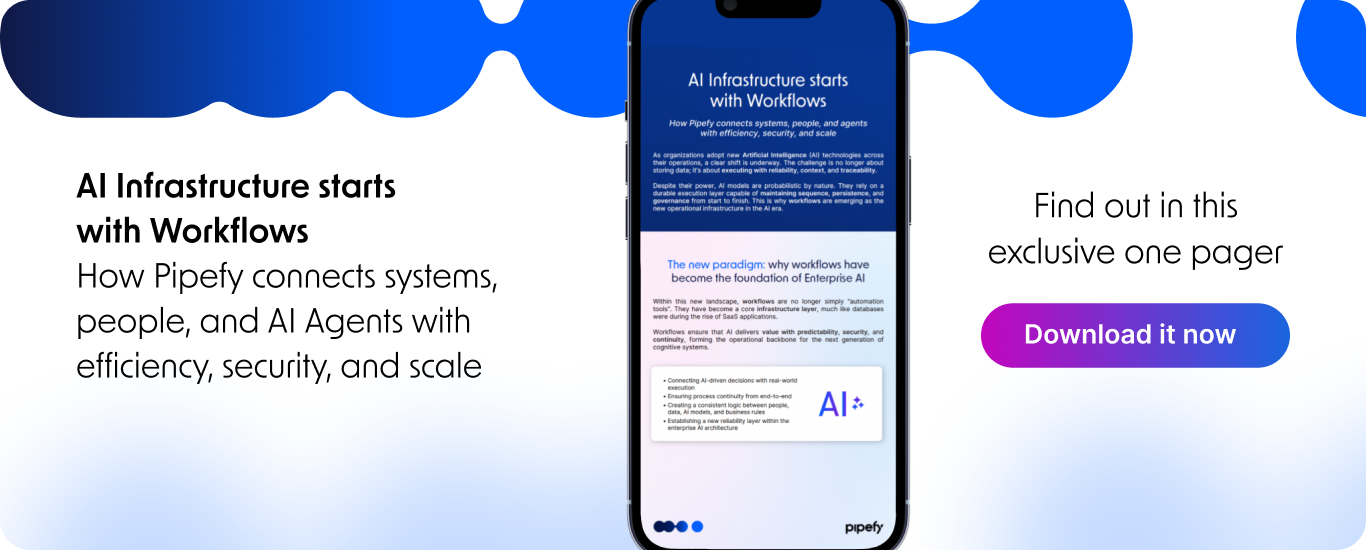
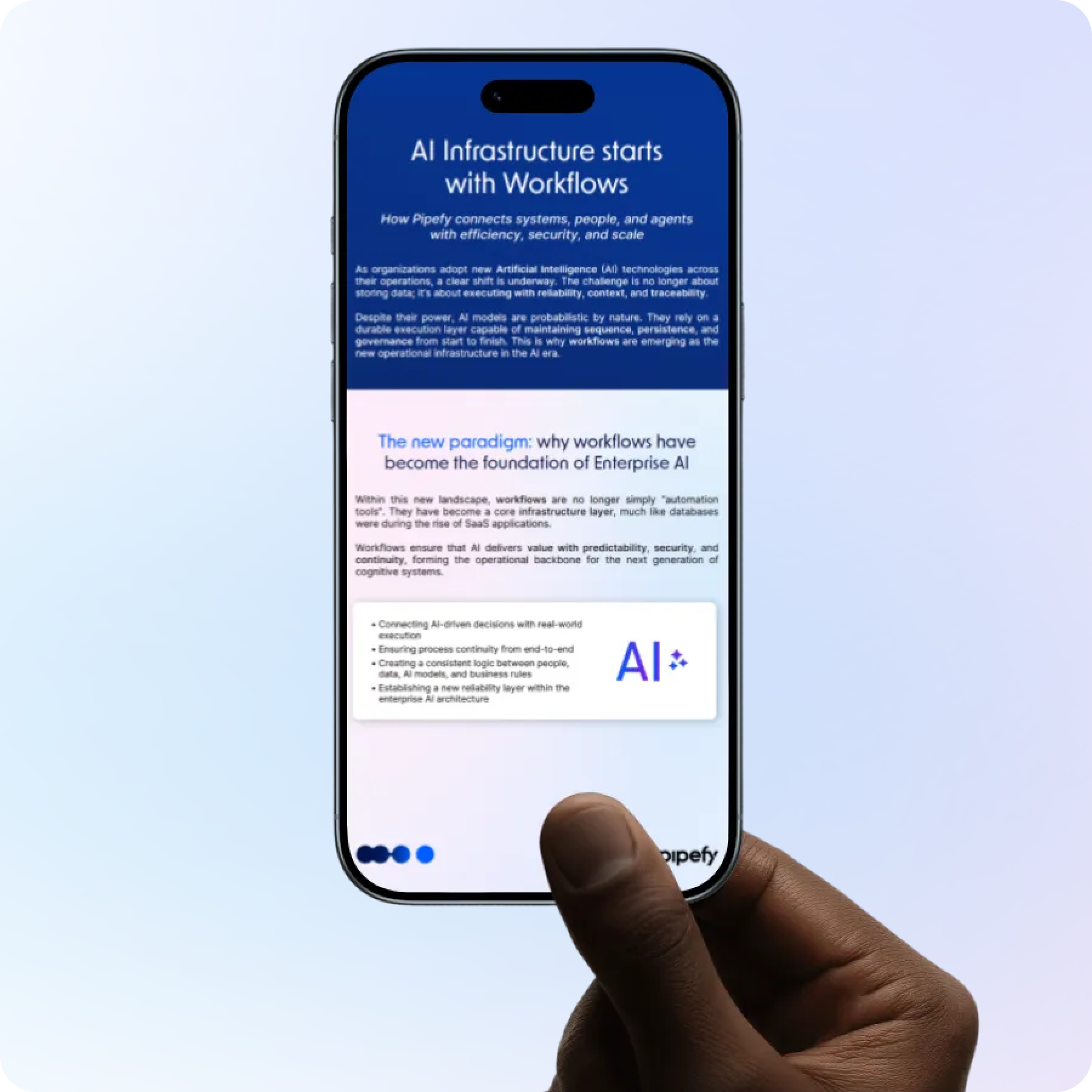
[One Pager] AI Infrastructure starts in workflows: how Pipefy connects systems, people, and AI Agents with efficiency, security, and scale
Meet Pipefy’s Integration Hub
The Integration Hub is Pipefy’s iPaaS solution, which connects critical systems, triggers automations, orchestrates end-to-end data flows, and enables the coordinated action of AI Agents. It centralizes all integrations into a secure and governed layer directly within the platform’s own infrastructure.
Integrations become a core capability of the product rather than a parallel tool, allowing IT and operations teams to operate flows with visibility, control, and scale.
By reducing fragmentation, reliance on external integrators, and operational risks, the Integration Hub delivers measurable ROI in days, not months, with simple implementation and enterprise-grade governance.
The solution offers cutting-edge capabilities and features for complex integrations, including:
- Over 500 ready-to-use connectors (SaaS, CRMs, ERPs, databases, corporate systems, and internal APIs)
- Creation of flows/recipes by dragging and dropping triggers, actions, and logical steps (low-code)
- Industry-standard authentications: OAuth, API Key, Basic Auth, and Service Accounts
- 100% execution on Pipefy’s infrastructure, with observability, limits, logs, and enterprise-grade governance
Who is Pipefy’s Integration Hub for?
It is built for enterprise companies with multiple core systems and strict requirements for compliance, auditability, and reliability, especially those facing restrictions on approving third-party solutions and needing integrations that are governed and approved by IT.
With Pipefy, you ensure a simple experience for non-technical users, while remaining powerful enough for advanced builders. Trusted by IT. Orchestrated in Pipefy.
Click the button below to discover how to boost your technological architecture with Pipefy’s Integration Hub: