ARTICLE SUMMARY
A Shared Services Center (SSC) is a centralized business unit that consolidates support functions like HR, Finance, and IT. It operates as an internal service provider to improve efficiency, standardize processes, and reduce costs, allowing the core business to focus on strategic growth and innovation.

How a shared services center strategy automates high-volume backoffice workflows and drives enterprise efficiency.
In the pursuit of operational excellence, enterprises often face a common hurdle: fragmentation. As companies grow, departments like Finance, HR, and IT tend to develop their own siloed processes, leading to redundancy, data inconsistencies, and soaring costs.
To solve this, mature organizations turn to a strategic consolidation model. But what is a Shared Services Center, exactly?
More than just centralizing people in one location, a Shared Services Center (SSC) represents a fundamental shift in how business support functions are delivered. It transforms internal departments into service providers focused on efficiency, quality, and measurable results.
In this article, we will explore the shared services center definition, how it differs from traditional centralization or outsourcing, and how modern orchestration platforms are enabling these centers to deliver value in days, not months.
What Is a Shared Services Center?
To understand what is a Shared Services Center, we must look beyond geography. An SSC is a dedicated business unit within an enterprise tasked with supplying specific operational tasks, typically high-volume and repetitive, to multiple divisions or regions of the organization.
Unlike a simple centralized department, an SSC operates like a business within a business. It has defined service level agreements (SLAs), clear costs, and a mandate to treat internal departments as customers.
The SSC meaning lies in this service-oriented mindset: delivering standardized, cost-effective support while allowing the core business units to focus on strategy and growth.
How Does a Shared Services Center Work?
The centralized services model works by decoupling support functions from the business units they serve. Instead of each regional office having its own Accounts Payable team, for example, these functions are consolidated into a single entity.
However, consolidation is just the first step. A mature shared services model relies on standardization, governance, and AI-powered workflow orchestration.
Requests from various departments, such as employee onboarding or vendor payments, are routed to the SSC, where they are processed according to uniform protocols.
Instead of merely digitizing processes, modern SSCs embed AI Agents into workflows, enabling autonomous task execution, intelligent decision-making, and real-time adaptability.
This structure allows the shared services organization to leverage economies of scale. By pooling resources, the SSC can invest in better technology and automation tools that would be too costly for individual departments to implement on their own.
Shared Services vs. Outsourcing
A common point of confusion is the difference between shared services vs outsourcing. While both aim to reduce costs and improve focus, the distinction lies in control and location:
- Shared Services: The function remains in-house. The company retains full control over the data, the process governance, and the culture. The intellectual property and process knowledge stay within the organization.
- Outsourcing (BPO): A third-party provider manages the function. While this can lower costs, it often introduces risks related to data privacy, loss of control, and a disconnect from company strategy.
Additionally, unlike traditional BPO models that externalize execution, AI-powered Shared Services Centers internalize intelligence.
With AI Agents operating within governed workflows, organizations retain full visibility, auditability, and strategic control, without sacrificing scalability.
What Functions Are Typically Included in a Shared Services Center?
SSCs typically handle transactional, high-volume processes that do not require physical proximity to the core business stakeholders. Common functions include:
- Finance & Accounting (P2P, O2C, R2R): Accounts payable, accounts receivable, general ledger, expense reimbursement, and financial reporting.
- Human Resources (HRSD): Payroll processing, benefits administration, employee onboarding/offboarding, and employee data management.
- Information Technology (IT): Help desk support, infrastructure management, and application maintenance.
- Procurement: Purchase requisitions, vendor management, and contract administration.
- Legal: Contract review, compliance checks, and document management.
To truly optimize these high-volume workflows, modern SSCs are moving beyond static management to AI-driven orchestration.
This means embedding specialized AI Agents into each critical process — from Finance to HR to Procurement — creating a multi-agent system capable of executing, validating, analyzing, and escalating tasks autonomously, under human supervision.
Platforms like Pipefy demonstrate how this shift works in practice by connecting disparate systems and teams within a unified layer.
In complex cycles like Procure-to-Pay (P2P) or HR Service Delivery (HRSD), Pipefy allows SSCs to deploy AI Agents that autonomously handle tasks, from document validation to supplier communication, illustrating how technology can drive efficiency and scalability without replacing the core ERP.
By consolidating and orchestrating these functions, business shared services create a streamlined operation capable of handling thousands of transactions with consistency.
Read more: How to automate the hiring process and eliminate repetitive tasks
Key Benefits of a Shared Services Center
Implementing a robust shared services strategy offers more than just headcount reduction. It drives systemic improvements across the enterprise:
- Cost Reduction: Economies of scale and eliminated redundancies significantly lower the cost per transaction.
- Standardization: Uniform processes reduce errors and compliance risks, crucial for global operations.
- Agility: A centralized unit can adapt to changes, such as new regulations or acquisitions, faster than disparate teams.
- Data Visibility: Centralized data allows for better analytics and decision-making.
The drive for these benefits is evident in the market. According to a Deloitte report, cost reduction remains a primary objective for 82% of SSC leaders, while 86% emphasize standardization and process efficiency as their top priority to drive value.

Shared Services Center Implementation: Step-by-Step
Building a global shared services center is a complex journey that requires careful planning.
To ensure a successful deployment and minimize operational disruption, consider this structured roadmap:
- Assessment: Identify which processes are standardized enough to be moved to an SSC.
- Design: Define the shared services governance model, SLAs, and the organizational structure.
- Technology Selection: Choose a platform that can orchestrate workflows across systems without replacing the core ERP.
- Migration: Move processes in waves (e.g., starting with Finance) to minimize disruption.
- Optimization: Continuous improvement using automation and data insights.

What Metrics Should a Shared Services Center Track?
To ensure the SSC delivers value, performance must be rigorously measured. A balanced scorecard approach is essential to avoid focusing solely on cost at the expense of quality.
Consider tracking the following key performance indicators (KPIs) to maintain a healthy and efficient operation:
| Metric Category | Key Performance Indicator (KPI) | Description |
| Efficiency | Cost Per Transaction | Total cost of the function divided by the volume of transactions processed |
| Quality | First Contact Resolution (FCR) | Percentage of requests resolved during the first interaction |
| Speed | Cycle Time / SLA Adherence | The time taken to complete a process from start to finish against the agreed standard |
| Satisfaction | Net Promoter Score (NPS) | Internal customer satisfaction with the service provided |
Orchestrating SSCs with Pipefy: AI and Governance
Even with a defined structure, many SSCs struggle with the “last mile” of efficiency. They face a fragmented tech stack where legacy systems (ERPs, CRMs) don’t talk to each other, leading to data silos and manual workarounds.
This is where Pipefy steps in. The platform provides an AI-powered orchestration layer built on BPM, connecting systems of record, systems of engagement, and systems of enrichment into a unified execution environment.
At the core of this model is Pipefy’s System of AI Agents: autonomous (or supervised) agents capable of creating tasks, making decisions, and executing workflows across multiple platforms.
From Manual Tasks to AI-Driven Orchestration
Pipefy empowers SSCs to move beyond basic task management. By leveraging AI Agents, teams can automate complex decisions and execution within the workflow.
For example, in a Procure-to-Pay (P2P) process, Pipefy’s AI Agents can autonomously perform 3-way matching, validate compliance documents, cross-check external databases, trigger anomaly detection models, and escalate exceptions through governed workflows, all while maintaining structured logs that ensure full observability and audit readiness.
It’s a shift that marks the evolution from automation to autonomation, where AI Agents don’t just follow predefined rules but dynamically interpret context, apply business rules, interact with other agents, and adapt to changing inputs.
This approach delivers time-to-value in days, not months. Instead of waiting for lengthy IT projects to build integrations, business teams can use Pipefy’s no-code environment to build, modify, and optimize workflows autonomously.
Read more: Supplier Management Automation: Streamline Your Procurement Processes
Governance and Security
For the IT persona and the “Guardians” of the company, Pipefy ensures that this autonomy doesn’t come at the cost of control.
The platform offers enterprise-grade governance with full audit trails. Unlike black-box AI tools, Pipefy brings agent execution to the frontend, providing structured logs field-by-field and phase-by-phase.
This transparent observability ensures that IT and compliance teams maintain full control over AI behavior, permissions (RBAC), and data governance. It also eliminates the risks of unmanaged automation while giving the SSC the flexibility it needs to scale.
By centralizing operations on Pipefy, Shared Services Centers transform from cost centers into strategic partners, delivering measurable ROI and operational agility.
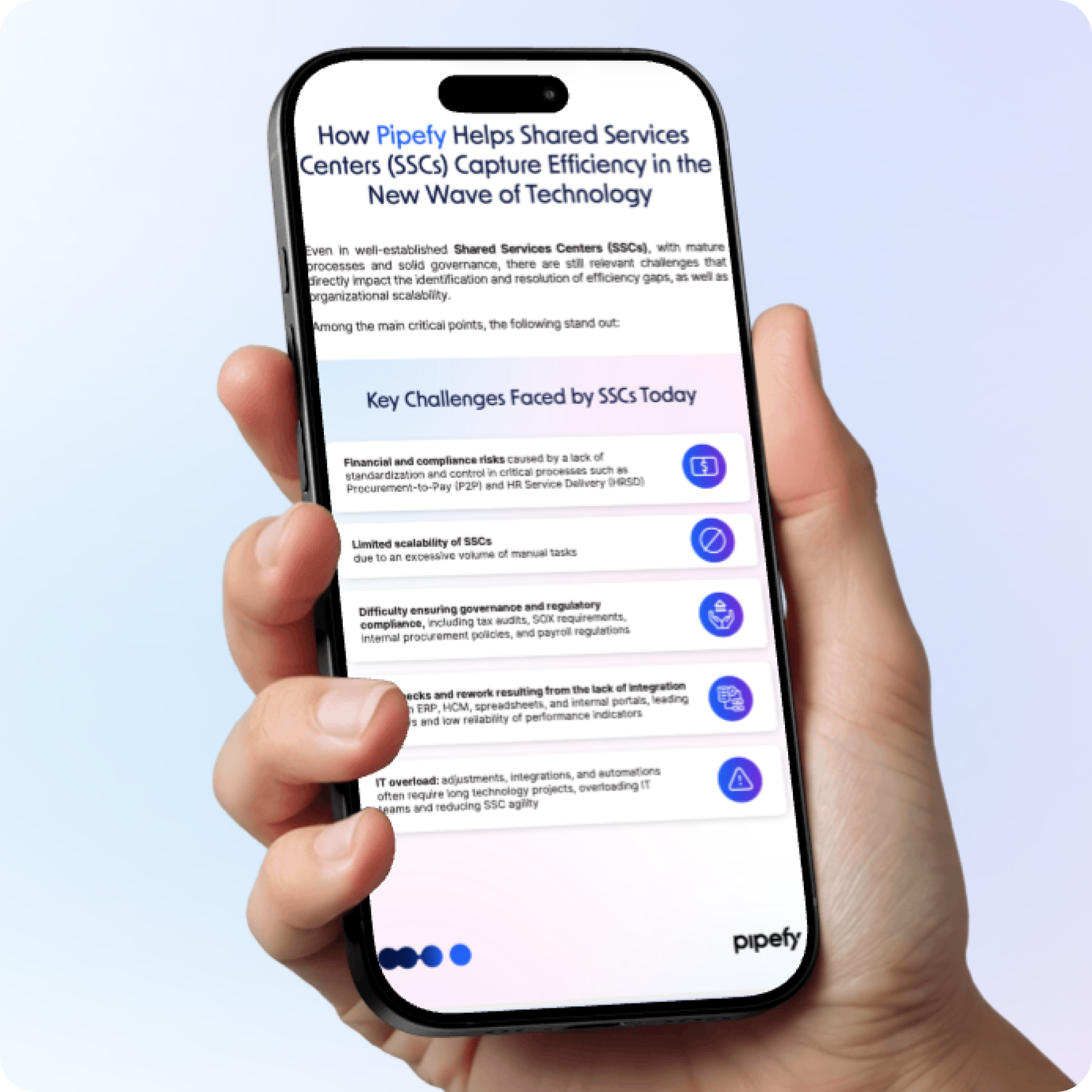
See how Pipefy orchestrates SSC efficiency in action:
[One Pager] Find out how Pipefy helps SSCs capture efficiency and transform into intelligent orchestration hubs