ARTICLE SUMMARY
AI workflows are intelligent processes that integrate Artificial Intelligence to automate complex tasks, analyze unstructured data, and orchestrate actions across systems. By connecting people and AI Agents, they enable organizations to scale operations with efficiency, ensuring governance and reducing manual work without increasing headcount.

Orchestrate intelligent workflows to drive enterprise efficiency and governance without increasing headcount
In the current business landscape, the challenge is no longer just about adopting new technologies, but how to make them work together effectively. As organizations rush to integrate Artificial Intelligence, they often encounter a fragmented reality: isolated tools, data silos, and a lack of governance.
AI workflows emerge as the solution to this chaos, serving as the connective tissue that orchestrates systems, people, and digital agents into a cohesive operation.
In this article, we will explore the definition of AI workflows, their key components, and how to implement them to achieve enterprise-grade scalability with security. Learn more below.
What are AI workflows?
AI workflows are sequences of automated processes that leverage Artificial Intelligence to execute tasks, process data, and make decisions with varying degrees of autonomy.
Unlike traditional static processes, which follow a rigid “if this, then that” logic, these intelligent flows can interpret context, adapt to unstructured data, and learn from patterns.
In modern enterprise environments, AI workflows do more than automate tasks. They provide the structured execution layer that enables AI Agents to operate with autonomy, governance, and contextual awareness.
This evolution represents a shift from simple task execution to true AI workflow automation. It moves beyond basic data entry to handle complex cognitive tasks, such as analyzing legal contracts, triaging customer support tickets based on sentiment, or validating financial risks, without constant human intervention.
By embedding AI directly into the process layer, organizations create a durable execution infrastructure. This ensures that operations run smoothly and predictably, delivering measurable value in days, not months.

Key components and architecture
To build intelligent workflows that are both resilient and scalable, it is essential to understand their structural anatomy. A robust architecture transforms a standard process into a dynamic system capable of orchestration.
The main components include:
- Triggers: The event that initiates the flow, such as a new email, a form submission, or a database update.
- Data Layer: The centralized context where information from various systems (ERPs, CRMs) is gathered and normalized.
- Cognitive Layer (AI Agents): This is where machine learning workflows distinguish themselves. AI Agents operate within structured workflows to analyze inputs, make contextual decisions, execute actions across systems, and escalate exceptions when necessary. This is where AI workflows become agentic.
- Human-in-the-Loop: A critical governance checkpoint where human experts review low-confidence AI decisions or approve sensitive actions.
- Integrations: The bridges that allow the workflow to push and pull data across the company’s tech stack.
Traditional Workflows vs. AI Workflows
| Feature | Traditional Workflows | AI Workflows |
| Data Handling | Structured data only (forms, rows) | Unstructured data (emails, PDFs, images) |
| Flexibility | Rigid, rule-based logic | Adaptive, context-aware decision making |
| Maintenance | High effort; requires constant updates | Learns and adapts; easier to scale |
| Scope | Task-specific automation | End-to-end workflow orchestration |
Learn more: What Is Process Orchestration and Why It Matters for Business Operations
Main business use cases
AI process automation is reshaping how departments operate by removing bottlenecks and reducing manual work.
AI workflows become exponentially more powerful when combined with AI Agents operating within them. Platforms like Pipefy enable organizations to build, orchestrate, and govern these AI-driven workflows from a single environment.
Here is how different sectors are applying these technologies:
Finance and Procurement
In financial operations, automated decision workflows are revolutionizing accounts payable and receivable.
Pipefy’s platform, for instance, enables finance teams to deploy AI Agents that extract data from invoices, match them against purchase orders, and validate tax information automatically.
For companies in highly regulated sectors, leveraging financial services with AI ensures that these automations maintain strict compliance and auditability. If an anomaly is detected, the workflow routes the case to a human analyst; otherwise, it proceeds to payment integration, reducing cycle times and eliminating errors.
Human Resources
Teams are implementing AI-driven processes for Human Resources to streamline onboarding and recruitment. Instead of manual data entry, AI workflows built on Pipefy can parse resumes, schedule interviews, and provision IT access for new hires.
By orchestrating these steps, the platform ensures a seamless experience from day one, allowing HR professionals to focus on culture and strategy rather than paperwork.
Customer Operations
Service desks use AI-powered automation to triage incoming requests. AI analyzes the request content, categorizes it by urgency and topic, and routes it to the correct agent or resolves it automatically.
With Pipefy, this triage happens in real-time, significantly improving Service Level Agreements (SLAs) and ensuring that customer queries are handled with speed and context.
How to build and implement AI workflows
Designing effective enterprise AI workflows requires a strategic approach that prioritizes “time-to-value” and simplicity over complexity. The goal is to avoid long implementation cycles that deliver frustration rather than results.
Here is a step-by-step guide to help you orchestrate your first intelligent process:
- Map the Process: Identify high-volume, repetitive processes that involve unstructured data or multiple handoffs.
- Choose an AI-Native Workflow Platform: Select a solution like Pipefy that combines AI workflows, AI Agents, governance controls, and enterprise integrations in a single no-code environment.
- Define the Logic: Use AI workflow design principles to outline where the AI acts and where humans intervene.
- Integrate Systems: Connect your core systems (like Salesforce or SAP) without replacing them. The workflow should act as an orchestration layer on top of your existing stack.
- Test and Deploy: Launch the workflow in a controlled environment to validate the AI’s accuracy before scaling.
According to McKinsey, Generative AI has the potential to automate activities that consume 60% to 70% of employees’ time today. However, this potential is only realized when AI is governed and integrated into structured workflows.
Governance, risks, and monitoring
As companies scale AI workflow automation, governance becomes the protagonist. Without it, organizations risk creating “Shadow AI”, unmonitored automations that create security vulnerabilities and operational opacity.
To mitigate these risks, automated decision workflows must be built with “compliance by design.” This includes maintaining immutable audit trails of every action taken by an AI Agent. It is crucial to enforce role-based access controls (RBAC) and ensure that sensitive data is handled according to regulations like GDPR and SOC2.
AI workflows must also eliminate the “black box” effect often associated with Generative AI tools. By operating inside structured workflows, AI Agents inherit business rules, approval layers, and audit trails, ensuring transparency and compliance by design.
Effective monitoring involves real-time dashboards that track the performance of both human and AI Agents. This visibility ensures that the technology remains an asset, not a liability, providing IT leaders with the control they need to govern AI adoption across the enterprise.
Read more: AI Governance: How Pipefy Mitigates Risks and Ensures Safe Use of Artificial Intelligence
Best practices and common mistakes
When implementing intelligent workflows, success lies in pragmatic execution.
Best Practices
- Start with Impact: Focus on processes where you can prove ROI quickly.
- Prioritize Governance: Establish guardrails for AI behavior from the start.
- Empower Business Teams: Use low-code tools to allow operations teams to build and adjust their own AI workflows without constantly depending on IT backlogs.
- Build AI Agents on Structured AI Workflows: Deploy intelligence only after processes are clearly defined. AI workflows ensure scalability, governance, and measurable impact.
Common Mistakes
- Over-automating: Trying to remove humans entirely from complex decision loops too early.
- Ignoring Unstructured Data: Failing to leverage AI’s ability to process documents and emails.
- Fragmented Approaches: Building isolated automations instead of a unified orchestration strategy.

Orchestrating the future with Pipefy
The future of enterprise scalability lies in AI workflows; not as isolated automations, but as structured execution layers that enable AI Agents to operate safely and intelligently across the organization.
Pipefy transforms AI workflows into a governed System of Agents, combining business rules, contextual intelligence, and human oversight to multiply operational capacity without increasing headcount.
By combining no-code simplicity with powerful AI Agents, Pipefy enables organizations to achieve measurable impact in days, not months. Whether you are implementing AI workflow automation software for finance, HR, or customer service, the platform ensures your operations are scalable, audit-ready, and efficient.
Organizations using Pipefy report up to 40% reduction in manual activities, and with AI Agents embedded into AI workflows, reductions can reach 60% to 90%, with payback in less than six months.
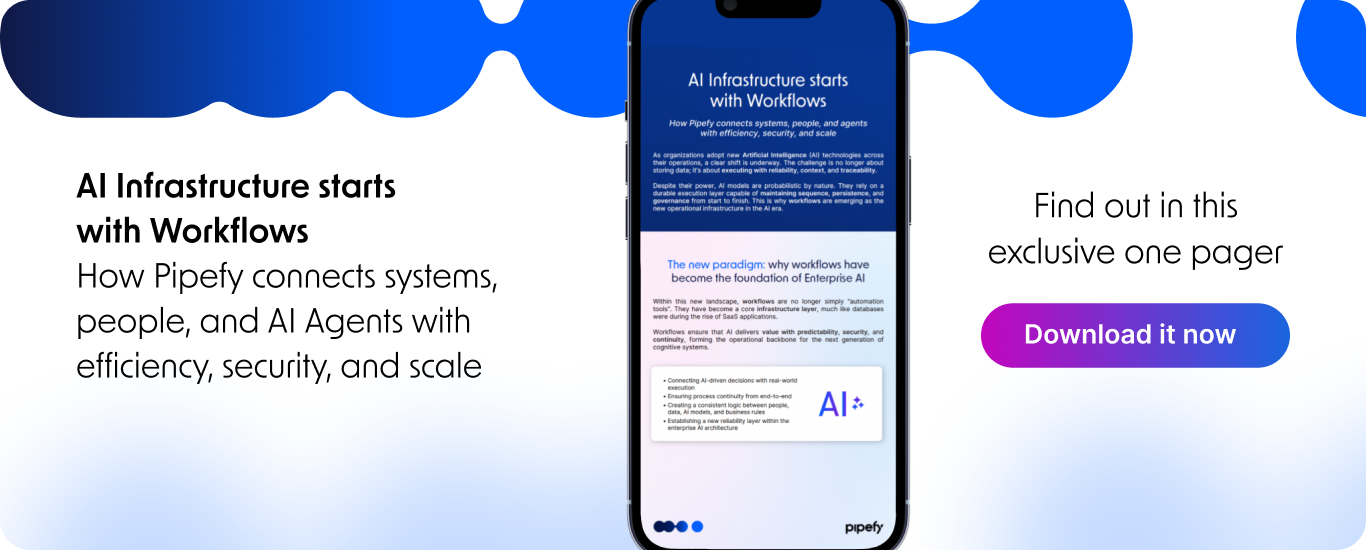
To dive deeper into this topic, check out our exclusive one-pager, “AI Infrastructure starts with Workflows: How Pipefy connects systems, people, and AI Agents with efficiency, security, and scale”. It details how to build a durable execution layer that connects systems, people, and Agentic AI with efficiency, security, and scale at Pipefy:
[One Pager] AI Infrastructure starts with Workflows: How Pipefy connects systems, people, and AI Agents with efficiency, security, and scale
The transition from fragmented automation to a unified operation requires more than just adding AI; it requires a foundation that connects every part of your business.
By adopting a robust business orchestration platform, you move beyond simple task execution to a future where intelligence is woven into the very fabric of your company.
Pipefy provides the visibility and control necessary to bridge the gap between human expertise and machine speed, ensuring your digital transformation is both high-impact and low-risk.