ARTICLE SUMMARY
Embedded AI is changing how organizations scale by moving intelligence to local devices and software. Learn how this technology differs from Cloud AI, its main benefits for business orchestration, and how to implement it to achieve impact in days, not months.

In the current global market, organizations are racing to adopt Artificial Intelligence (AI) and Agentic AI solutions, yet there is a significant gap between implementation and value.
While McKinsey reports that 72% of organizations have already adopted AI in at least one business function, achieving significant financial returns remains a challenge for many.
This hurdle often stems from a lack of integration between intelligence and the actual execution of tasks. As businesses seek to scale, local intelligence is emerging as a critical solution to bridge this gap, allowing for real impact and results.
In this article, we’ll explore the rise of Embedded AI in business process orchestration and its critical role in enabling scalable operations.
We’ll understand the fundamental differences between cloud and edge intelligence, the strategic benefits of local processing, and how enterprise-grade orchestration allows organizations to achieve measurable impact in days, not months.
What is Embedded AI and how does it work?
To understand this technology, we must first answer a common question: what is Embedded AI? At its core, Embedded AI refers to the integration of machine learning models directly into hardware or software systems rather than relying exclusively on centralized cloud servers. These systems perform computations locally on what is known as On-device AI or Edge AI.
The process works by optimizing a machine learning model so it can run on specialized hardware with limited resources. Instead of sending data to a distant data center, the device processes the information instantly where it is generated.
This local intelligence allows for autonomous decision-making in real time, which is fundamental for modern business orchestration and automation technology.
For Pipefy, this local intelligence is a key component of a unified orchestration layer that allows business teams to create workflows and AI Agents in minutes, ensuring agility without bypassing security.
What is the fundamental difference between Embedded AI and Cloud AI?
The primary distinction in the Cloud AI vs Edge AI debate lies in where the “brain” of the operation resides.
While Cloud AI uses massive clusters of servers to process data, local systems utilize the immediate environment to execute tasks. This decentralization is essential for maintaining performance in complex enterprise environments.
Let’s compare the main differences between them in the table below:
| Feature | Cloud AI | Embedded AI / Edge AI |
| Location | Remote data centers | Local device or specific system |
| Latency | Higher (depends on network) | Near-zero (instant processing) |
| Connectivity | Requires constant internet | Can operate offline |
| Security | Data transferred over networks | Data stays on the device (privacy) |
| Scalability | High for training large models | High for massive local deployment |
It is also important to clarify a related technical term: what is an embedding in AI?
While the names are similar, an embedding is a mathematical representation of data (such as words or images) in a vector space.
While embeddings are used in many models, Embedded AI specifically refers to the deployment of the entire model on local systems.

What are the main benefits of Embedded AI?
Adopting local intelligence offers several strategic advantages for enterprise-grade operations. One of the most significant is the elimination of latency, as decisions are made in milliseconds. This is vital for processes requiring instant verification or safety responses.
Furthermore, privacy is greatly enhanced because sensitive data does not leave the local environment, making it easier to maintain compliance with strict data regulations.
From a financial perspective, processing locally reduces the massive bandwidth and cloud subscription costs associated with constant data transfers.
By integrating local intelligence within Pipefy, organizations gain real-time decision intelligence while ensuring integrated governance, security, and compliance at scale, from departmental automations to cross-functional orchestrations.
What are the technical challenges of implementing Embedded AI?
Despite the benefits, moving intelligence to the edge requires overcoming specific hurdles. The most significant challenge is the hardware limitations of the devices themselves. Unlike a data center, AI on microcontrollers or mobile devices has limited memory and power.
This has led to the rise of TinyML (Tiny Machine Learning) and Embedded Machine Learning, which focus on shrinking models without sacrificing accuracy. Developers must use techniques like quantization and pruning to ensure Embedded Systems AI can perform complex logic within a small footprint.
Reaching high efficiency often requires following the 30% rule in AI, which suggests that for a task to be effectively automated, at least 30% of the training data should be high-quality and specific to the target environment to ensure reliable performance.
In which industries and products is Embedded AI already a reality?
This technology is currently transforming sectors such as manufacturing, retail, and financial services. By integrating Embedded Machine Learning into daily operations, companies are finding new ways to handle high volumes of data without overwhelming their infrastructure.
Practical Example
Let’s consider a fictional example in the consumer goods industry. Imagine a large global manufacturer that manages thousands of quality control checks on a production line.
If the company relied solely on the cloud, any lag in the internet connection would cause the line to stop.
With Pipefy, by using local intelligence in the cameras on the factory floor, the system would detect defects instantly, trigger a rerouting workflow that connects critical systems (such as ERPs or CRMs) without replacing them, and alert the manager immediately.
This approach ensures that the operation remains agile and secure.

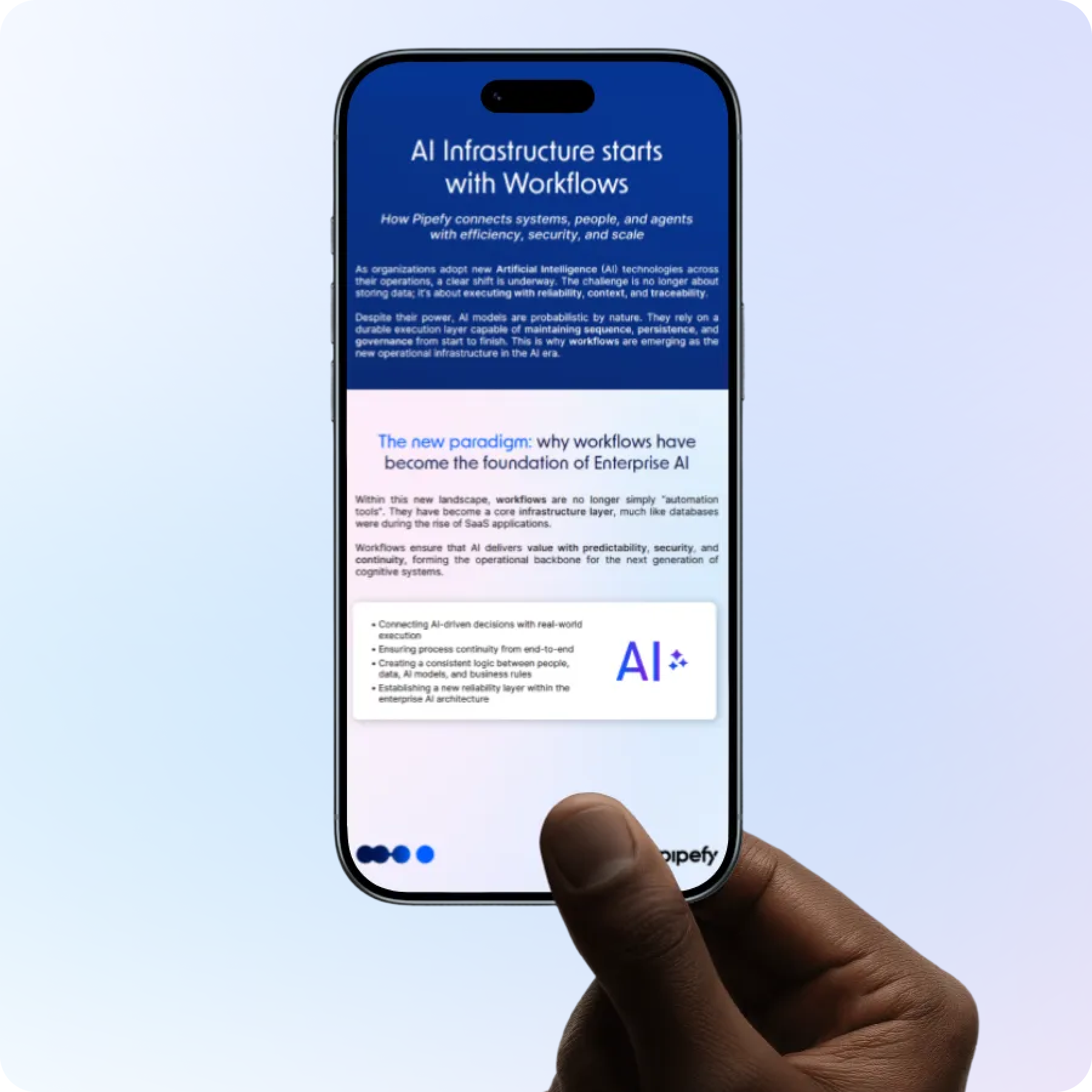
[One Pager] AI Infrastructure starts with Workflows: How Pipefy connects systems, people, and AI Agents
What is the future of Embedded AI and its impact on technology?
The future of technology is moving toward a unified agentic automation platform. Gartner predicts that, by 2029, 70% of enterprises will deploy Agentic AI within their infrastructure operations, a significant jump from less than 5% today. This shift will be supported by the increasing maturity of local processing.
As hardware becomes more powerful and models become more efficient, every business tool might have its own layer of intelligence. This will result in a more resilient and autonomous digital ecosystem where humans and AI operate in full collaboration.
Learn more: 10 Technology Trends That Will Impact Companies in 2026
Orchestrate your business impact with Pipefy
Pipefy is the platform that transforms automation into business results. By combining AI Agents, workflow automation, and no-code, Pipefy allows you to deliver real financial impact in days, not months.
The platform connects critical systems and eliminates the chaos of spreadsheets and emails through an enterprise-grade orchestration layer. Your team can create and evolve workflows using natural language, gaining autonomy without increasing the IT backlog.
Whether you are looking to improve SLA or achieve a high ROI, Pipefy’s infrastructure is built to scale with your organization while maintaining the highest standards of governance and security.
Click the button below to schedule a demo and find out how an orchestration and automation platform like Pipefy can accelerate your operations: