ARTICLE SUMMARY
Shared services workflows are structured, repeatable sequences of tasks that centralize and automate back-office operations. By establishing clear rules, routing requests efficiently, and connecting legacy systems with governed AI, these workflows eliminate manual bottlenecks, improve SLA compliance, and scale internal service delivery.

Back-office operations face constant pressure to deliver faster results while controlling costs and maintaining strict compliance. However, relying on fragmented systems, disconnected spreadsheets, and manual emails creates operational bottlenecks that severely delay service delivery.
To overcome these barriers and achieve true scalability, business leaders should implement a structured approach to process management. Adopting shared services workflows brings order, governance, and predictability to these critical routines.
In this article, we will explore how standardizing these processes can drive operational efficiency and scale your back-office. Read more below.
What are shared services workflows?
Shared services workflows are clearly defined, repeatable sequences of tasks designed to handle internal business requests. These workflows structure the lifecycle of a service, organizing internal service delivery between departments from the initial intake to the final resolution.
They differ significantly from traditional decentralized operational structures. Instead of relying on scattered emails, loose spreadsheets, and informal verbal requests, which often lead to the proliferation of unsecured Shadow IT, these workflows act as a business orchestration and automation layer.
They establish:
- A single, unified and secure channel for intake.
- Predefined rules for approval and execution that strictly enforce corporate governance.
- Clear visibility into the status of every ongoing demand, ensuring full auditability for IT and compliance teams.
What is the role of shared services in modern organizations?
Adopting a robust shared services model fundamentally changes how a company sustains its growth. The primary purpose of this structure is centralizing support functions such as HR, Finance, IT, and Procurement.
By consolidating these administrative areas into enterprise shared services, organizations prevent the duplication of efforts across different business units. This approach improves operational efficiency and governance by ensuring that all internal policies, compliance requirements, and security standards are strictly enforced.
How shared services workflows operate in practice
In a centralized environment, chaotic processes are replaced by a predictable logic. Internal requests are submitted, routed, approved, and fulfilled within a shared services structure following strict business rules.
This systematic operation relies on several core mechanisms to maintain order:
- Request management: All demands enter through standardized forms that require mandatory information upfront.
- Service queues: Approved tasks are automatically placed into specific queues based on priority and team capacity.
- Standardized processes: Every step follows a mapped path, ensuring nothing bypasses corporate governance.
Departments that typically operate through shared services workflows
Virtually any department handling a high volume of transactional requests can benefit from centralized service operations.
The table below outlines common shared service functions across different corporate areas:
| Department | Common Workflow Applications |
| HR Service Centers | Employee onboarding, vacation requests, benefits management, and offboarding |
| Finance Operations | Accounts payable, expense reimbursements, invoice processing, and month-end close |
| Procurement Teams | Purchase requests, supplier onboarding, quote comparisons, and contract renewals |
| IT Help Desks | Access provisioning, equipment requests, software troubleshooting, and incident management |
| Facilities Management | Maintenance requests, workspace booking, and physical security access |
Learn more: End-to-end supply chain orchestration: how it transforms operational performance in 2026
Common operational challenges in shared services environments
Managing shared services operations without an orchestration layer exposes the business to several chronic issues. Without a unified system, leaders struggle with a lack of visibility into bottlenecks and team performance.
Some of the most frequent challenges include:
- Inefficient request handling due to missing information.
- Inconsistent service delivery across different business units.
- Heavy reliance on manual processes and error-prone data entry.
- Lost demands buried in email-based requests.
- Difficulties managing service-level agreements (SLAs) and tracking deadlines.
- Fragmented workflows across unvetted SaaS tools create massive blind spots, making it impossible to guarantee data privacy or pass rigorous SOC2/ISO audits.
- Relying on point-to-point, hard-coded scripts (spaghetti code) to connect legacy systems to modern requests cripples IT’s ability to scale operations.
How structured workflows improve shared services operations
Effective shared services management requires discipline. Workflow standardization directly attacks operational chaos by establishing clear boundaries and rules for execution.
When processes are structured, organizations instantly improve:
- Request routing: Tasks are automatically assigned to the right specialist without manual triage.
- Approval processes: Managers receive consolidated data, speeding up decisions.
- Service delivery consistency: Every request is handled following the exact same compliance rules.
- Workload distribution: Managers can balance task volumes evenly across the team.
- Performance tracking: Leaders gain real-time data to measure output against SLAs.

Key components of effective shared services workflows
To function correctly, shared services center workflows must be built upon specific structural components that enforce governance.
A reliable workflow architecture includes:
- Structured request forms: To prevent incomplete submissions.
- Automated routing and approval rules: To bypass manual handoffs and ensure compliance.
- Service catalogs: To guide users toward the exact service they need.
- SLAs and task ownership: To set clear deadlines and define who is accountable.
- Centralized visibility: To provide a single source of truth for operational processes.
The role of workflow automation in shared services
Automation changes the dynamic of shared services process management by shifting the focus from execution to strategy. Applying automation reduces manual tasks, enforces process consistency, and speeds up approvals.
This enables scalable internal service delivery workflows without requiring a proportional increase in headcount.
The impact of this technology is highly measurable. According to Deloitte’s 2025 Global Business Services Survey, approximately 58% of organizations have already begun or are planning their Generative AI journey to achieve key objectives like cost reduction, process standardization, and improved end-to-end ownership. Finance and IT are leading the implementation of AI tools to handle tasks like invoice management and analytics.
This is exactly where Pipefy steps in as an intelligent orchestration layer. By embedding governed AI Agents directly into the workflow, Pipefy allows shared services teams to automate these repetitive data extraction and routing tasks autonomously.
Through an Adaptive Governance Framework, IT can establish ‘Safe Zones’, secure, compliant environments where business users can build and modify workflows autonomously.
This governed execution empowers citizen developers while entirely eliminating the security risks of shadow IT, connecting legacy systems seamlessly, delivering a proven ROI and massive productivity gains in a matter of days.
Tools used to manage shared services workflows
To handle cross-department demands seamlessly, organizations must adopt the right technology stack. Relying strictly on email threads or disconnected spreadsheets is no longer viable for growing enterprises.
Modern operations require a robust technological ecosystem to ensure speed, visibility, and governance. The essential tools include:
- Workflow management platforms: Establish clear, automated paths for request routing and approvals, bypassing manual handoffs.
- Business Process Automation (BPA): Eliminates repetitive tasks and orchestrates different operational phases into a single execution flow.
- Internal service portals: Provide a unified, user-friendly interface for employees to submit requests using standardized forms.
- Integration layers: Connect legacy systems (such as ERPs and HCMs) to ensure data consistency and prevent siloed information across departments.

Why shared services workflows are essential for scalable organizations
As an enterprise grows, administrative complexity scales alongside it. Without structured internal service workflows, companies eventually hit a productivity ceiling, forced to hire more personnel just to manage the administrative burden.
Implementing structured workflows supports operational scalability, accelerates digital transformation, and guarantees governance. This structure ensures consistent service delivery across growing organizations, proving that true efficiency comes from intelligent orchestration.
Use Case: Procure-to-Pay (P2P)
Consider a fictional global enterprise struggling with its Procure-to-Pay cycle. If this company were to deploy Pipefy, it could use governed AI Agents to autonomously read supplier proposals and validate quotes against internal policies.
The agents would then route the approved data directly to the existing ERP via native integrations, eliminating manual data entry and drastically reducing the purchasing cycle time while maintaining strict compliance.
In this scenario, the shared services workflow acts as a ‘Legacy Orchestration Layer’ (or ERP Wrapper). It delivers a modern, agile digital experience for the users while keeping the core ERP system untouched.
This ‘two-speed IT’ approach eliminates manual data entry and modernizes operations without the prohibitive cost and systemic risk of replacing or heavily customizing the legacy core.
Metrics to evaluate shared services workflow performance
You cannot scale what you cannot measure. Tracking internal service delivery workflows requires robust analytics to ensure the operation remains healthy and efficient.
To properly evaluate performance, leaders should monitor five critical KPIs:
- Request resolution time.
- SLA compliance and average response times.
- Request backlog and queue volume.
- Process cycle time from intake to completion.
- Service quality and overall operational efficiency.
How Pipefy supports shared services workflows
Pipefy acts as an intelligent orchestration layer that bridges the operational gaps between legacy systems, business teams, and communication channels.
As a comprehensive business orchestration and automation platform, Pipefy empowers back-office teams with rapid time-to-value, delivering AI results in days, not months.
Built with enterprise-grade security (ISO 27001, SOC2), its SSC Suite‘s capabilities include service request portals, workflow automation, standardized process templates, SLA tracking, and centralized process management.
Most importantly, it features robust ERP integration, connecting with systems like SAP, Oracle, and Workday without replacing them, establishing a continuous, traceable flow.
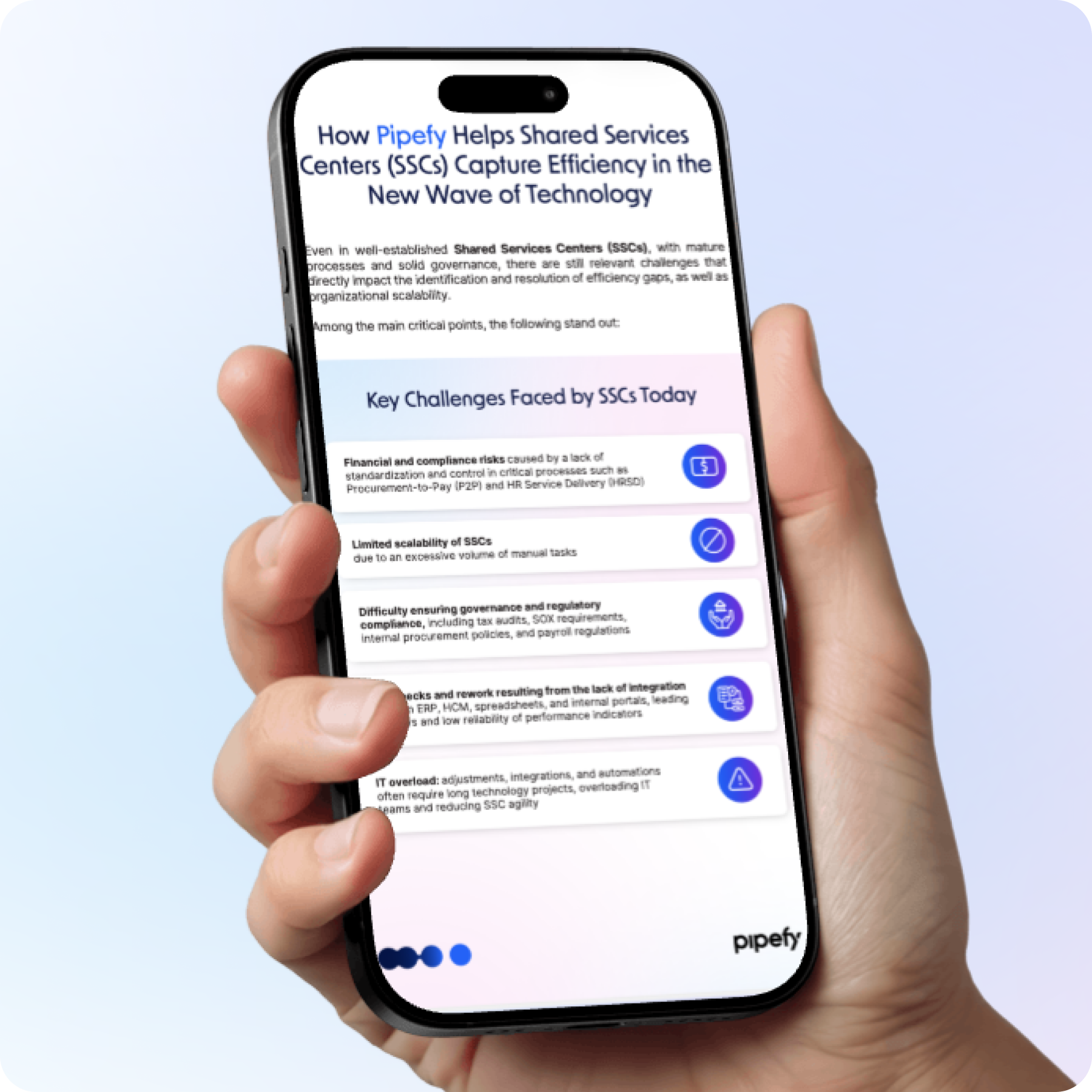
To dive deeper into how your organization can modernize these operations, we invite you to read this exclusive one-pager: “How Pipefy Helps Shared Services Centers (SSCs) Capture Efficiency in the New Wave of Technology”.
This material covers:
- How to overcome bottlenecks and compliance risks in critical processes like P2P and HR Service Delivery.
- The impact of low-code/no-code orchestration combined with AI Agents.
- Real-world use cases proving up to 40% more efficiency in SSCs.
Click the button below to download the material for free:
[One Pager] How Pipefy Helps Shared Services Centers (SSCs) Capture Efficiency in the New Wave of Technology