ARTICLE SUMMARY
Agentic orchestration is an emerging category that connects the AI your team already uses to the critical processes that run across your company's systems. In this article, you'll find a practical 5-step framework to break out of pilot and capture real value with AI Agents in days, not months.
Most companies that adopted Generative AI in the past two years still face the same frustration: isolated experiments, scattered financial returns, and ROI stuck on the step between adoption and value capture. According to the Widening AI Value Gap 2025 study by the Boston Consulting Group, 60% of companies fail to extract any material return from AI, even with substantial investment.
The cause isn’t the model or the volume of data; it’s the architecture. When AI is connected only to isolated systems like CRMs, ERPs, or spreadsheets, it speeds up tasks “inside a box,” but the critical process that needs to cross three, four, or five systems to be completed keeps running the same old way.
The category that answers this gap is agentic orchestration, and implementing it is simpler than it sounds, as long as you apply a practical framework.
In this article, we’ll detail what agentic orchestration is, why now is the right moment to start, and the step-by-step approach to break out of pilot in a matter of weeks, with AI Agents executing governed processes end to end.
What is agentic orchestration
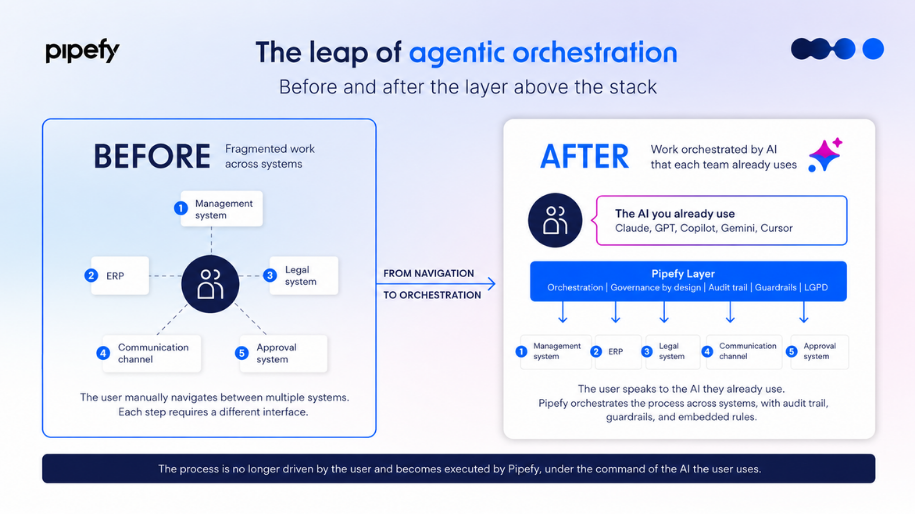
Agentic orchestration is the category that connects AI Agents to the workflows that run across an enterprise’s core systems. Instead of just reading data or suggesting answers, AI now executes the process from start to finish, with approval, audit trails, and business rules embedded in the workflow itself.
The difference from traditional automation is architectural:
- Traditional automation: executes pre-programmed tasks within fixed rules.
- Isolated Generative AI: answers questions and generates content, but operates without process context.
- Agentic orchestration: connects AI, core systems, and business rules into a single executable workflow, with governance applied to the process design itself.
The practical difference becomes clear in the leap from fragmented work across systems to work orchestrated by the AI each team already uses:
Why start now: the 12-to-18-month window in Latin America
Timing matters more than it seems. Latin America is living through a rare window of opportunity: today, Brazil is the second-largest user of Generative AI in the world, yet ranks only 58th in deep enterprise adoption.
At the same time, none of the global agentic AI solutions was built with regional context in mind. Payroll, eSocial, labor compliance, and Brazilian tax rules still aren’t covered natively by international players.
This localization gap opens a 12-to-18-month window before global players adapt their products to the region — meaning whoever captures value first will define the category locally.
For companies operating in Brazil, it’s a historic opportunity to skip a technology generation in business processes with AI, exactly as happened with Mobile Banking, PIX, and WhatsApp in recent years.

Practical framework: 5 steps to get started with agentic orchestration
Most enterprise AI initiatives fail not from lack of technology, but from lack of method. Pilots start without a clear selection criterion, governance becomes a parallel layer, and the first results rarely get measured at all.
The framework below corrects these three failures and works for any industry and department. Each step plays a specific role in building the full cycle, from diagnosis to the first process in production, in weeks rather than months.
1. Map the critical process that runs across your stack
Start with the process that consumes the most time in your operation and involves three or more systems to be completed. Some classic examples across different areas:
- HR: Employee onboarding
- Finance: Accounts payable
- Credit: Credit analysis
- Procurement: Purchase order approval
- Legal: Contract renewal
The point isn’t to start with the most sophisticated process, but with the one carrying the highest coordination cost today.
2. Connect your core systems without replacing them
Agentic orchestration doesn’t ask you to swap out SAP, Salesforce, Workday, ServiceNow, or Microsoft 365. It requires a layer above the stack that coordinates the work running across all of them. The systems of record stay where they are; what changes is how the process flows between them.
3. Apply governance to the workflow itself
Instead of keeping audit trails, RBAC, SLA, and LGPD/GDPR as an overlaid security layer, these rules get embedded directly into the workflow design. AI doesn’t skip steps, doesn’t create records without required fields, and doesn’t move cases without meeting conditionals, because the process doesn’t allow it.
4. Connect the AI your team already uses
Claude, ChatGPT, Copilot, Gemini, Cursor: your team has probably already adopted one or several of these assistants. Agentic orchestration connects these LLMs to your governed processes, instead of asking your company to adopt yet another AI tool. The user asks in natural language, in the interface they already know, and the process happens behind the scenes.
5. Measure the first results in days, not months
Before you start, define which metrics will tell you whether the process is capturing value:
- SLA compliance
- Hours saved
- Documented ROI
- Exception rate
- Throughput
Without predefined metrics, pilots never move to production. With them, the first process in production becomes the launching point for expansion.
Isolated AI vs. agentic orchestration: the difference in practice
| Scenario | Isolated AI (pilot) | Agentic orchestration (production) |
|---|---|---|
| Where AI operates | Inside an isolated system | Across the process that crosses all systems |
| Governance | Policy layer (manuals, training) | By design (audit trails, RBAC, LGPD/GDPR in the workflow) |
| Time to value | Months or years | Days |
| Typical outcome | Speeds up isolated tasks | Captures measurable business value |
- Learn more: The Rise of Embedded AI in Business Process Orchestration: Why It Matters for Scalable Operations
3 common mistakes when implementing agentic orchestration
Even with a clear framework in hand, three mistakes commonly show up in almost every first attempt at agentic orchestration.
They aren’t about the technology itself, but about how the project is structured in its first weeks. When they go unnoticed, they turn what could be the first process in production into yet another pilot going nowhere.
Here are the three most frequent ones:
- Trying to start with the most complex process in the operation: begin with the critical process that is most frequent and measurable, not the most sophisticated.
- Replacing systems instead of orchestrating them: agentic orchestration is a layer above the stack, not a rewrite. Swapping out an ERP or CRM is an entirely separate decision.
- Applying governance as an overlaid layer: audit trails and business rules need to live in the workflow itself, not in parallel manuals.

Pipefy’s role in agentic orchestration
Pipefy is the orchestration and governance platform that connects people, systems, and AI Agents across the cross-functional processes of the enterprise, now executable by the AI each team already uses.
The platform doesn’t replace SAP, Salesforce, Workday, ServiceNow, or Microsoft 365. It sits above the existing stack and coordinates the work that runs across all of them, with native audit trails, RBAC, and LGPD/GDPR from the very first workflow.
Now, the conversation starts anywhere you want. The process happens in Pipefy.
See how it works in practice in the video below:
Practical example: Roca saves more than 1,200 hours in HR with Pipefy’s AI Agents
Roca, a global leader in bathroom solutions with more than 10,000 employees and operations in Brazil, adopted Pipefy as its orchestration platform for HR and, starting in 2025, activated AI Agents inside processes that were already automated.
In just 6 months, the operation saved more than 1,200 hours in the department, 640 of which came from reducing onboarding effort, and 147 of which came from AI Agents working in self-service.
This structural pattern was also measured by Forrester across Pipefy’s entire customer base: 260% average ROI, payback in less than 6 months, and a 40% reduction in manual tasks.
Roca is just one of the operations in production we explore in depth in an exclusive Pipefy report: “The Leap of Artificial Intelligence in Latin America: The Next ‘Leapfrog’ After WhatsApp, PIX, and Mobile Banking.”
Alongside Puma and Banco Sofisa, it stands among the Pipefy customer success stories that support the report’s central thesis: Latin America is facing a 12-to-18-month window to lead the next wave of enterprise AI.
In this report, you’ll see in detail:
- The Brazilian paradox in numbers: why Brazil ranks as the second-largest user of Generative AI in the world, yet sits at only 58th in deep enterprise adoption.
- The LATAM window of the next 12 to 18 months: why this is the historic moment for companies in the region to skip a technology generation with AI, before global players adapt their products to the local context.
- The step where enterprise AI value gets lost: market research explains why 60% of global companies still don’t capture material return from AI, even after substantial investment.
- Agentic orchestration in production: the three pillars that separate the design that captures value from the one stuck in pilot, with governance applied to the workflow itself.
- Real cases from Brazilian operations: Puma, Roca, and Banco Sofisa, with documented results across different areas using Pipefy’s AI Agents.
Download the report for free and discover how to use agentic orchestration to break out of your AI pilot: