ARTICLE SUMMARY
P2P software is the platform that runs the procure-to-pay process, from intake and approvals to invoicing and payment. The strongest options do more than store requests: they orchestrate the full flow across departments and systems, integrate with the ERP, and enforce compliance as the operation scales.
Buying P2P software is one of those decisions that looks like a feature comparison and turns out to be a strategy decision. Two platforms can tick the same boxes on paper and still deliver very different outcomes, because what matters is not the length of the feature list but how deeply the tool orchestrates your process and connects to the systems you already run.
Most comparison content stops at feature grids. This guide takes a different lens: a decision framework built around fit, integration depth, compliance, AI, and total cost of ownership, so you can evaluate options against your procurement strategy and your ERP stack rather than against a checklist of specs.
By the end, you will have a practical way to separate must-haves from nice-to-haves, plus a 10-question checklist to take into any demo.
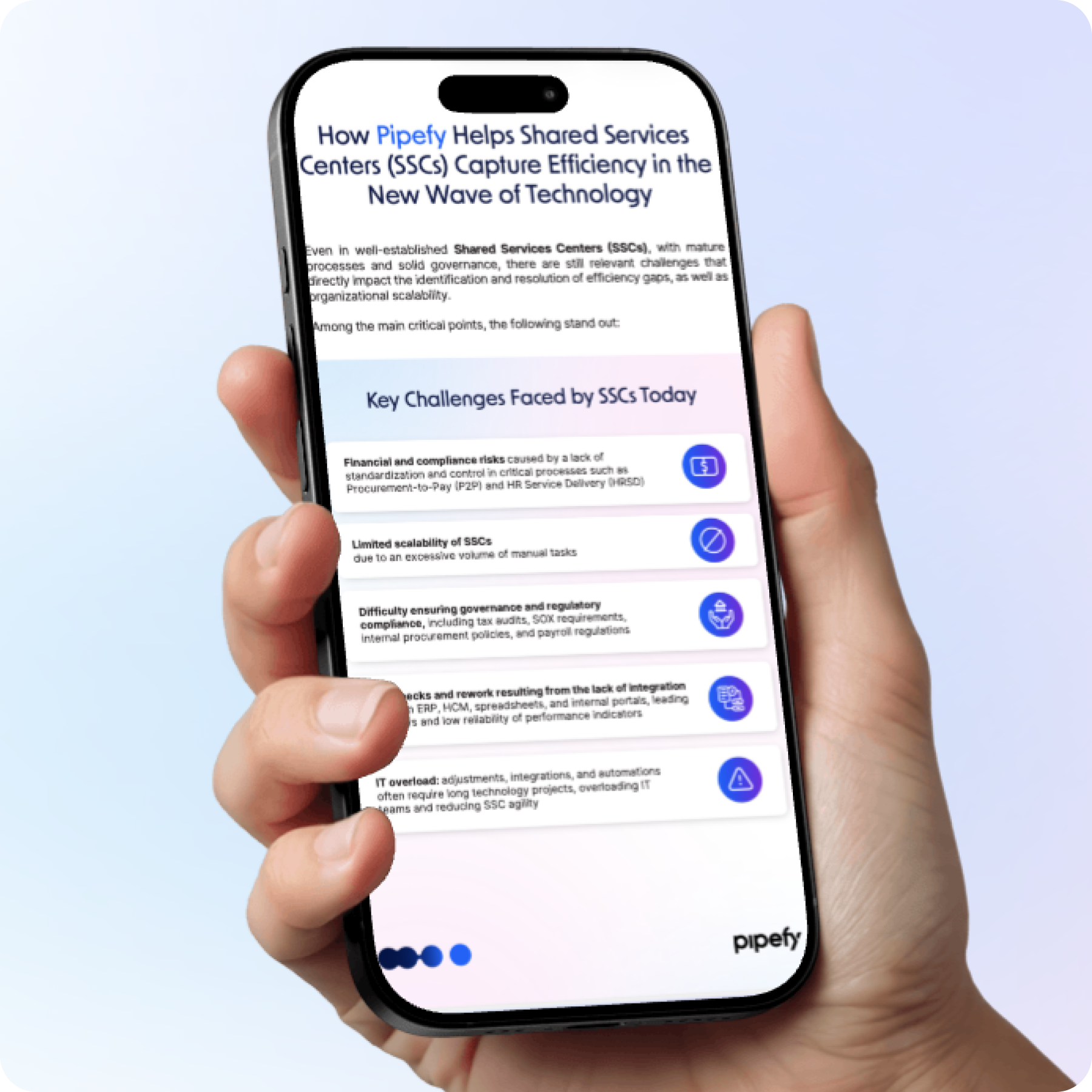
[One Pager] How Pipefy Helps Shared Services Centers (SSCs) Capture Efficiency in the New Wave of Technology
What to look for in P2P software in 2026
The category is mature, so most tools handle the basics: requisitions, approvals, purchase orders, and invoices. That is exactly why a feature-by-feature bake-off is a weak way to choose. The real differentiator in 2026 is orchestration depth, meaning how well the platform runs the whole flow across departments and systems, not just inside a single module.
Technology is now a strategic line item in procurement, not an afterthought. According to Deloitte’s 2025 Global Chief Procurement Officer Survey, the top-performing procurement organizations are allocating up to 24% of their budgets to technology, nearly double what they reported in 2023. When you are spending at that level, the platform you pick shapes the operating model for years.
So before comparing vendors, anchor the decision on three questions:
- Does it orchestrate the process from intake to payment?
- Does it fit the systems you already run?
- Will it scale with governance as volume grows?
Everything else is detail. This is also why a decision framework beats a feature matrix. Features tell you what a tool can do; fit tells you what it will actually do in your environment, with your systems and your team.
If you are still defining the process itself, start with the fundamentals in our guide to procure-to-pay.
Core capabilities vs nice-to-haves: a practical framework
A useful way to cut through vendor decks is to sort every capability into two buckets: table stakes that most tools now offer, and orchestration-grade capabilities that separate a system of record from a system that actually runs the work. A strong procure to pay software shortlist, sometimes labeled purchase to pay, should be built on the second bucket.
The table below frames the criteria that matter most, and what “good” looks like at the orchestration level:
| Capability area | Table stakes (most tools) | Orchestration-grade (hold out for this) |
| Intake | A digital request form | One guided intake for every category that feeds the whole flow |
| Approvals | Configurable routing | Deterministic, auditable routing across departments, not just within AP |
| Sourcing and RFQ | Store quotes and POs | Structured RFQs with comparison and negotiation captured in the flow |
| Three-way match | Match PO, receipt, invoice | Automated match with exceptions routed to people, not the reverse |
| Integration | Connectors to major ERPs | Orchestrates across ERP, CLM, and legacy systems without replacing them |
| AI | Assistants and suggestions | Agents that read, validate, decide, and act inside a governed flow |
| Compliance and audit | Logs and permissions | Policy enforced at intake, with one end-to-end audit trail |
| Configurability | Admin or IT configures | No-code, so business teams adjust flows without an IT project |
| Scalability | Handles higher volume | Adds processes, categories, and departments without re-architecting |
The pattern is clear: nice-to-haves live inside modules, while the capabilities that change outcomes live in the connections between them. That is the orchestration lens most feature grids miss.
To put the framework to work, turn each orchestration-grade row into a live demo request rather than a yes-or-no question on a form:
- Do not ask whether the tool has approvals; ask the vendor to route a real cross-department request in front of you and show the audit trail.
- Do not ask whether it has AI; ask an agent to read an invoice, match it to a PO, and flag an exception on screen.
- Do not ask whether it integrates; ask to see data move to and from a system like the one you run.
Watching a platform run one of your own scenarios from end to end reveals far more than any checklist, and it quickly separates the tools that record work from the tools that actually do it.
For the broader context on how these capabilities fit together, see our complete guide to procurement automation.

How to evaluate ERP integration depth
Integration is where P2P projects quietly succeed or fail. A platform that only connects cleanly to modern, API-first tools will not survive contact with the systems most enterprises actually run, and a platform that forces you to replace the ERP is solving the wrong problem.
The scale of the challenge is well documented. The MuleSoft 2025 Connectivity Benchmark Report found that the average enterprise now manages 897 applications, yet only 29% are integrated, and 90% of organizations report business obstacles caused by data silos. The same research notes that 80% of organizations cite data integration as their most significant obstacle to using AI.
When you evaluate a P2P software platform, treat integration as a first-class criterion, not a line in the appendix. Ask precise questions:
- Which connectors are native versus custom?
- What is handled by API or iPaaS?
- Does the ERP remain in the system of record?
- How does the tool handle older or heavily customized systems?
The best answer keeps your ERP as the source of truth and orchestrates on top of it.
It also helps to know the three ways platforms integrate. Native connectors are prebuilt and low-maintenance; open APIs are flexible but need engineering to build and keep current; and an iPaaS sits in between, brokering data across systems. The right mix depends on your stack, but the goal is constant: connections your team can sustain without a standing developer backlog.
Compliance, approval workflows, and audit trails
For regulated and audited enterprises, compliance is not a feature to switch on; it is a layer that has to apply at every step. The question is whether the platform enforces policy at the point of request, or lets exceptions slip through and catches them later.
Look for three things:
- Deterministic approval workflows that route by amount, cost center, and risk with every decision logged;
- Segregation of duties baked into the flow;
- One end-to-end audit trail that follows a request from intake to payment.
Strong procurement automation software makes the compliant path the default path, so people do not have to choose between speed and control.
This matters more as organizations scale, because control tends to break at the handoffs between teams. In the Deloitte survey mentioned above, siloed ways of working was named the number one barrier to delivering value, cited by 57% of procurement leaders. A platform that orchestrates across those silos is also the one that keeps compliance intact.
Read also: Shared Services workflows: how to standardize and scale back-office operations
AI-native vs AI-added procurement platforms: what it means in practice
Almost every vendor now claims AI, so the useful distinction is where the AI lives. AI-added platforms bolt a model onto existing modules to offer assistants and suggestions. AI-native platforms put agents inside the orchestrated flow, where they read documents, validate against policy, score risk, and take the next action, always with rules, audit trails, and human review for exceptions.
The difference shows up in returns, not demos. Deloitte’s 2025 CPO Survey found that the most digitally mature procurement organizations achieve an average 3.2x return on their generative AI investments, well ahead of the roughly 1.5x seen by followers. The gap is not about whether a tool has AI; it is about how deeply that AI is embedded in the process.
In practice, ask to see the AI act on a real request end to end, not just draft a summary. If the agent can read an invoice, match it, flag an exception, and update the ERP inside the workflow, that is AI-native. If it can only suggest text while a person still does the work, that is AI-added. For a modern e-procurement or P2P stack, that distinction is worth more than any feature count.
Total cost of ownership: beyond licensing fees
Licensing is the visible cost. The expensive part is everything around it: implementation, integration maintenance, ongoing dependency on IT, change management, and the opportunity cost of slow adoption.
Integration maintenance alone is a hidden drain. The MuleSoft research above found that IT teams spend 39% of their time creating custom integrations, and that 83% of organizations believe delays equate to lost revenue. A platform that needs a developer for every change quietly taxes the whole operation long after the contract is signed.
This is where no-code changes the math. When business teams can build and adjust workflows without an IT ticket, the total cost of ownership drops and time-to-value shrinks. When evaluating P2P software, model the three-year cost of ownership, not the first-year license, and weigh how much of the roadmap depends on scarce technical resources.
Adoption is the other silent cost. A platform the business finds hard to use gets bypassed, and shadow processes creep back in, eroding the very savings that justified the purchase. Ease of use for non-technical teams is a cost factor, not a nicety.

Learn more: Supplier Management Automation: Streamline Your Procurement Processes
Checklist: 10 questions to ask before buying P2P software
Use this list as a filter in any demo or proposal:
- Does the platform orchestrate the full flow from intake to payment, or only automate one leg, such as AP?
- Can business teams build and change workflows in no-code, without an IT project for each adjustment?
- Are there AI Agents that read, validate, and act inside the flow, with audit trails and human review for exceptions?
- Which ERP connectors are native, and does the ERP stay the system of record?
- How does it handle legacy or heavily customized systems, not just modern APIs?
- Is compliance enforced at intake, with deterministic approvals and one end-to-end audit trail?
- Does it scale to new categories, departments, and volumes without re-architecting?
- What does the three-year total cost of ownership look like, including integration maintenance and change management?
- How fast is time-to-value, and what does a realistic payback look like in comparable operations?
- Can the vendor show measurable outcomes, such as cycle time and ROI, in enterprises like yours?
The more of these a platform answers convincingly, the closer you are to a system that runs procurement rather than just records it.
The right platform is not the one with the longest feature list; it is the one that orchestrates your process, fits your ERP stack, enforces compliance, embeds AI where it acts, and keeps total cost of ownership in check. Score your options against those criteria and the shortlist gets clear fast.
Once you have chosen a platform, the next step is putting it to work. Our guide to procurement workflow automation walks through orchestrating P2P from intake to payment.
How Pipefy fits this framework
Measured against the criteria above, Pipefy is built for the orchestration end of the spectrum. With P2P AI Studio, the procure-to-pay flow runs from requisition to payment on no-code workflows, with AI Agents that validate requests, run quotes, check compliance, and support negotiation inside the process.
On integration, Pipefy acts as a layer that connects your ERP, CLM, and legacy systems rather than replacing them, keeping the ERP as the system of record.
On configurability, business teams own the workflows, so procurement and finance adjust the process without queuing IT change requests.
On proof, The Total Economic Impact study by Forrester found 260% ROI and payback in under 6 months for Pipefy customers.
To see how the orchestration approach drives efficiency across procurement and other back-office processes, download the one-pager below, then bring your top criteria to a Pipefy demo.
[One Pager] How Pipefy Helps Shared Services Centers (SSCs) Capture Efficiency in the New Wave of Technology