ARTICLE SUMMARY
Procurement workflow automation orchestrates every step of procure-to-pay, from intake and approvals to purchase orders, three-way matching, and payment, so work moves on rules and AI instead of manual handoffs. It connects procurement, suppliers, and finance in one governed flow that scales without adding headcount.
Most enterprises have already automated pieces of procurement: a form here, an approval rule there, an invoice-capture tool bolted onto the ERP. Yet the process as a whole still stalls, because the pieces do not talk to each other and every handoff is manual.
Procurement workflow automation solves the whole, not the parts. Instead of stitching point tools together, it orchestrates the entire procure-to-pay flow as one system, moving a request from intake to payment with rules and AI, and no manual handoffs between teams or systems.
That distinction, orchestration rather than another workflow tool, is what separates a faster inbox from a genuinely transformed operation. This guide shows how to get there: why workflows break at scale, what end-to-end orchestration looks like, how to automate each stage, and the results to expect.
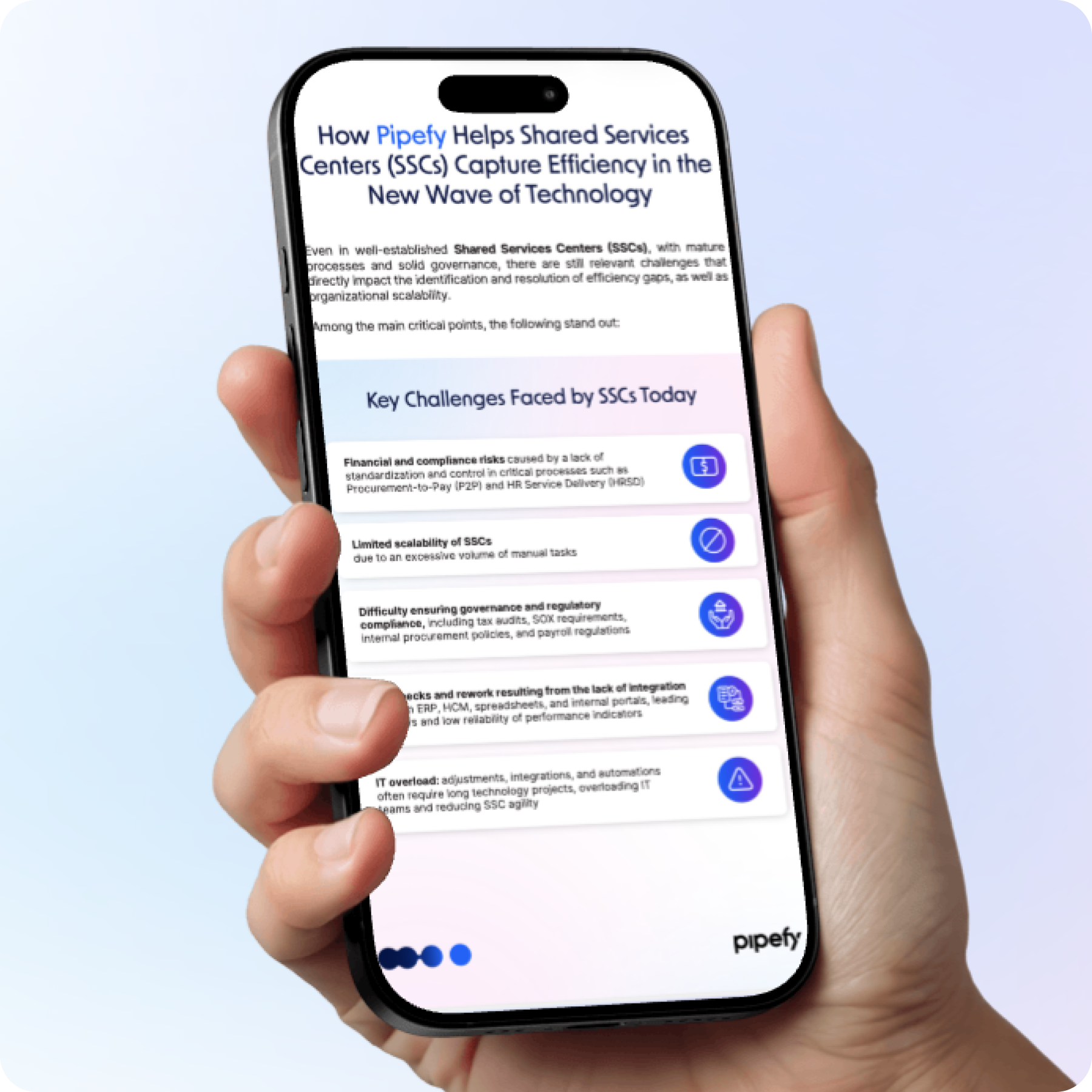
[One Pager] How Pipefy Helps Shared Services Centers (SSCs) Capture Efficiency in the New Wave of Technology
Why procurement workflows break down at scale
At low volume, manual procurement works. People know each other, requests are few, and gaps get patched by hand. At scale, that same informality becomes the bottleneck.
The failure is structural, not personal. Procurement spans intake, approvals, sourcing, receiving, and payment, and each handoff between those steps, and the teams that own them, is a place where information is lost, duplicated, or delayed. Add volume and the cracks widen.
The market has concluded that manual is no longer sustainable. In McKinsey’s 2024 procurement research, 90% of procurement leaders said digital processes to manage contracts and flag noncompliance and value leakage are now business-critical. Yet the default answer to rising volume, adding headcount, scales cost rather than capability.
Procurement workflow automation breaks that link by letting the process, not people, carry the routine load.

What orchestrated procurement looks like end to end
Orchestration means the whole flow runs as one connected system. A request enters through a single intake, moves through rule-based approvals, becomes a purchase order, is received and matched, and is paid, with data flowing cleanly from step to step and the ERP staying the system of record. The contrast with the manual version is stark.
| P2P step | Manual and siloed (before) | Orchestrated (after) |
| Intake | Email, spreadsheets, and portals; requests arrive incomplete | One guided intake captures category, budget, and cost center up front |
| Approvals | Chased by email, stuck in inboxes | Deterministic routing by amount and risk, every decision logged |
| Sourcing and RFQ | Quotes scattered across threads | Structured RFQs and comparisons captured in the flow |
| Purchase order | Keyed into the ERP by hand | POs generated, dispatched, and recorded in the ERP automatically |
| Receipt and three-way match | People reconcile PO, receipt, and invoice | The system matches; only true exceptions reach a person |
| Exceptions | Found late, often in audits | Flagged in real time, with a clear owner |
| Visibility | Reports assembled after the fact | Real-time status, cycle time, and spend across the flow |
| Scaling | Add headcount as volume grows | Add processes and volume without adding people |
The difference is not speed on any single task; it is that no one has to carry work across the gaps by hand. That is why orchestration is a platform capability, part of the broader move to procurement automation, not a feature you switch on. Delivering it end to end is exactly what procurement workflow automation is for.
See also: What is Procure-to-Pay (P2P)? Concept, steps, and benefits explained
Automating intake, approvals, PO creation, and 3-way matching
The core of purchase to pay automation is turning the four highest-friction stages into a hands-off flow.
Intake becomes a single guided form that captures category, budget, and cost center, so requests arrive complete. Approvals follow a deterministic chain by amount, cost center, and risk, with every decision logged. Purchase orders are generated, dispatched, and recorded in the ERP without manual keying. And three-way matching reconciles PO, receipt, and invoice automatically, sending only true exceptions to a person.
Inside a platform like Pipefy’s P2P AI Studio, specialized AI Agents do the repetitive work at each stage: a validation agent checks requests against policy and budget, a quotation agent runs RFQs and builds comparisons, a compliance agent scores risk, and a negotiation agent runs structured rounds. People stay in the loop for judgment, not data entry.
Connecting procurement workflows to supplier onboarding and contract management
Procurement does not begin at the PO or end at payment. The strongest orchestration reaches upstream to supplier onboarding and across to contract management, so the same governed flow covers the entire relationship.
Supplier onboarding is often the slowest, riskiest gate. Automating it with a tool like Pipefy’s SRM AI Studio collapses registration from around 15 days to 4 hours and cuts registration errors, with compliance checks built in before the first PO. On the contract side, connected contract management keeps terms, approvals, and renewals in the same fabric, so what was negotiated is what gets enforced when buying happens.
Joining these pieces is also how you keep risk in check. Supplier risk management becomes continuous rather than a periodic audit, because supplier data lives in the flow.
In short, a modern e-procurement stack treats onboarding, buying, and contracts as one connected process, not three disconnected ones.
Learn more: End-to-end supply chain orchestration: how it transforms operational performance in 2026
AI-driven exception handling and compliance monitoring
Automation handles the routine; AI handles the messy middle. Exceptions, a price mismatch, an out-of-policy request, a duplicate invoice, are where manual processes lose the most time and where AI adds the most value.
In an orchestrated flow, AI Agents flag exceptions the moment they appear, route them to the right owner with full context, and recommend a resolution against policy. Compliance stops being a periodic review and becomes continuous monitoring, with every action captured in one audit trail.
The guardrails matter as much as the automation. Strong procurement automation software keeps humans in the loop for sensitive decisions, enforces segregation of duties, and makes the compliant path the default, so speed never comes at the cost of control.
How to implement procurement workflow automation without a long IT project
The biggest fear at this stage is a multi-year IT program. It is also avoidable. Unlike traditional IT workflow automation that depends on developers for every change, no-code orchestration lets business teams build and adjust the flow themselves.
A sound rollout is incremental. Start with one high-volume process, such as invoice intake or a single spend category, prove the result, then expand. Connect the ERP and existing systems instead of replacing them, so the source of truth stays put and there is no rip-and-replace. Because the workflows are no-code, procurement and finance own the changes while IT governs rather than builds.
That approach turns a daunting transformation into a series of quick wins, each one live in weeks rather than quarters. If you are still comparing options, our guide on how to choose the right P2P software covers the criteria to weigh first.

Expected results: cycle time, spend visibility, and compliance rates
Orchestration pays off in three currencies: time, visibility, and control.
On cycle time, the gains are dramatic. In Pipefy’s P2P AI Studio, the procure-to-pay cycle drops from around 20 days to minutes at the most automated stage, with requisition-to-approval up to 99% faster.
On visibility, real-time status and spend data replace after-the-fact reports, so leaders see bottlenecks as they form.
On compliance, a single audit trail and policy enforced at intake turn control into a byproduct of the flow, not a separate effort.
The financial case is documented. The Total Economic Impact study by Forrester found 260% ROI and payback in under 6 months for Pipefy customers, with 40% of time saved on automated tasks. That is the return procurement workflow automation is built to deliver.
Success Story: how ZEISS cut purchasing lead time from 30 to 7.5 days with Pipefy
ZEISS, the global optics and optoelectronics leader with more than 40,000 employees, is a concrete example. Running on robust systems like SAP but held back by spreadsheets and email for critical workflows, ZEISS adopted Pipefy to orchestrate more than 70 processes in under two years.
In purchasing specifically, lead time dropped from 30 days to 7.5 days, the same team now handles nearly 50% more orders per hour, and the company saves more than 762 hours every month across key processes.
[One Pager] How Pipefy Helps Shared Services Centers (SSCs) Capture Efficiency in the New Wave of Technology
Orchestrate your P2P from intake to payment with Pipefy
Procurement workflow automation is the step where P2P stops being a chain of manual handoffs and becomes one orchestrated flow, from intake to payment, that scales without adding people. The tools are ready; the real decision is choosing orchestration over another point tool.
The fastest way to know what that means for your operation is to see it on your own processes. Book a Pipefy demo to walk through orchestrating P2P from intake to payment: