ARTICLE SUMMARY
Credit workflow automation is the orchestration of the entire B2B credit lifecycle, from application and KYC to decision and monitoring, in a single governed flow. Instead of manual, disconnected steps, it combines a rules engine, AI, and integrations to approve faster, reduce risk, and scale without adding headcount.
Extending credit to other businesses fuels growth, but it also carries constant risk. When approvals depend on spreadsheets, email threads, and manual checks, every new application adds time, cost, and the chance of a wrong decision.
The numbers show how much is at stake. According to Atradius, half of all B2B invoices in the United States are currently overdue, and bad debts average around 8% of all B2B credit sales. Deciding well, and quickly, protects both revenue and margin.
This is where credit workflow automation comes in. More than digitizing forms, it orchestrates the full credit lifecycle in a single flow, from the first application to post-disbursement monitoring, connecting data, business rules, people, and systems.
This guide covers the complete picture: why manual processes break at scale, what the B2B credit lifecycle looks like end to end, the core capabilities of a modern platform, how AI and rules engines work together, how to integrate with your existing systems, how to stay compliant, and how to evaluate and implement a solution.
[E-Book] Financial Services Outlook: Trends Reshaping the Industry and an Action Plan for Leaders

What is credit workflow automation and why manual credit processes fail at scale
Credit workflow automation is the use of workflows, integrations, and AI to run the credit process end to end, from application to decision and monitoring, without manual handoffs between people and systems. Instead of isolated tools, the operation runs as one connected, traceable flow.
Manual credit processes tend to fail for structural reasons, not because teams lack effort. Work is fragmented across spreadsheets, inboxes, and disconnected systems, so applications sit in queues, data is rekeyed at every step, and no one has a single view of where a case stands.
Manual review also makes decisions inconsistent. The same applicant can get different answers depending on who handles the file, fraud signals slip through when data sits in silos, and good customers are turned away for lack of a standard. Every one of those outcomes carries a direct cost, in losses or in revenue left on the table.
That inefficiency is expensive. According to Deloitte, credit analysis teams spend roughly 40% of their time simply gathering and reviewing data by hand, time that could go to complex cases and strategic decisions.
The cost compounds at scale. In B2B, deals are large, several stakeholders are involved, and compliance requirements are strict, so every day a case waits in an approval queue means a delayed deal and a frustrated customer. The traditional fix, hiring more analysts as volume grows, raises cost without solving the root problem.
The demand side adds pressure. In the Federal Reserve’s 2024 Small Business Credit Survey, 59% of small employer firms sought new financing, yet only 41% of applicants received all the funding they applied for. Faster, more consistent decisions are a competitive advantage, not just an efficiency gain.
The gap between the two models shows up at every stage of the operation:
| Dimension | Manual credit process | With credit workflow automation |
| Intake & data | Emails, spreadsheets, and rekeying at each step | Guided intake with automatic enrichment from the company ID |
| KYC / KYB & fraud checks | Manual lookups across separate tools | Automated verification in seconds, consolidated in one view |
| Credit scoring | Analyst pulls and interprets data by hand | Bureau and internal data scored automatically |
| Decisioning | Varies with each analyst’s judgment | Rules engine and AI applied consistently to every case |
| Approvals & exceptions | Back-and-forth email chains | Deterministic routing with a clear owner for each exception |
| Monitoring | Periodic and reactive | Continuous, with early-warning signals after funding |
| Visibility & audit | Low, hard to reconstruct | Real-time status and a full audit trail |
| Scale | Add headcount as volume grows | Absorb volume without adding headcount |
The full B2B credit lifecycle: from application to decision and monitoring
The reason credit process automation matters is that credit is a lifecycle, not a single step. Automating one stage while the others stay manual only moves the bottleneck. The goal is to orchestrate the whole journey as one flow.
A typical B2B credit lifecycle runs through seven stages:
- Application and intake: a guided form captures the request, required documents, and consent, so the case arrives complete.
- Onboarding and identity verification: KYC and KYB confirm who the business is, against public and private sources.
- Data enrichment and scoring: bureau data, financials, and behavior are pulled in and turned into a credit score.
- Credit decisioning: a rules engine applies the credit policy to recommend approval, decline, or human review.
- Approval, limits, and exceptions: deals within policy clear automatically, while higher-risk cases route to the right authority.
- Contract and disbursement: agreements are generated and signed digitally, and the decision flows to the systems of record.
- Ongoing monitoring: the portfolio is watched for early signs of delinquency and changes in risk after funding.
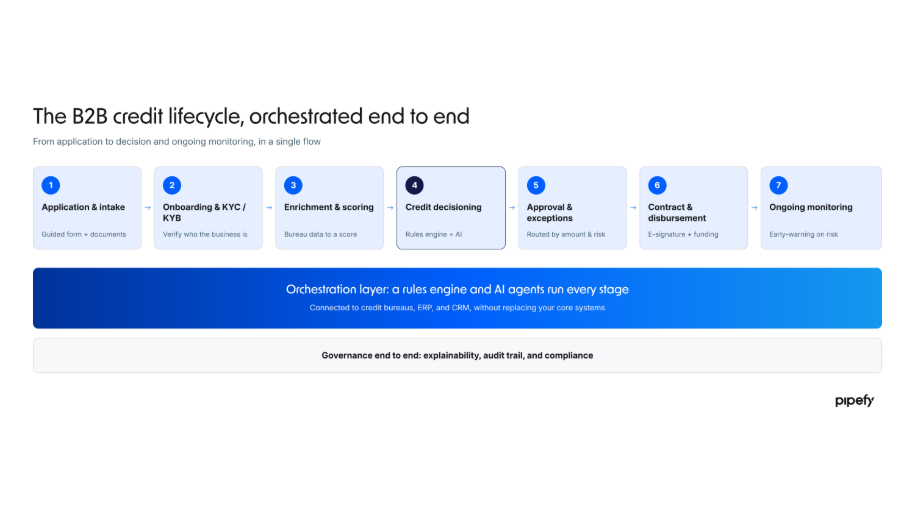
When these stages live in separate systems, information is lost at every handoff. When they are orchestrated in one automated credit workflow, each stage triggers the next automatically, and the data and audit trail travel with the case from application to monitoring.
Core capabilities of a credit workflow automation platform
Not every tool that calls itself automated delivers true orchestration. The capabilities below are what separate a modern B2B credit automation platform from a digital filing cabinet.
- Guided intake and document capture: standardized forms plus OCR that reads and extracts data from IDs, financial statements, and contracts.
- KYC, KYB, and background checks: automated verification against fraud, sanctions, and legal databases.
- Scoring and data enrichment: real-time bureau and external data attached to each application.
- Rules engine and decisioning: the credit policy expressed as explicit, versioned rules.
- Approval routing and exception handling: deterministic routing by amount and risk, with a clear owner for every exception.
- E-signature and contract generation: agreements created and signed inside the same flow.
- Portfolio monitoring: continuous tracking that flags delinquency risk before it becomes a loss.
- Dashboards, audit trail, and integrations: real-time visibility, a complete record of every decision, and native connections to the systems you already run.
Delivered together, these capabilities turn credit from a series of manual handoffs into a governed system that scales. Delivered as disconnected point tools, they simply recreate the silos they were meant to remove.
How AI and rules engines work together in automated credit decisions
The strongest credit decisioning workflow combines two layers: a rules engine and AI. They solve different problems, and the value comes from using both.
The rules engine enforces the credit policy. It applies thresholds, limits, and approval authorities the same way to every application, so an automated credit approval reflects company policy rather than the interpretation of an individual analyst. The output is consistent, fast, and repeatable.
AI adds a predictive layer on top. Instead of only checking fixed cutoffs, models estimate the probability of default, suggest an appropriate limit, and support risk-based pricing, which makes it possible to say “yes” with more confidence to applicants a generic cutoff would reject.
AI Agents also take over the repetitive work at each stage, from reading and extracting document data to summarizing checks and drafting the credit file, so people stay in the loop for judgment, not data entry.
The market is moving quickly. In a McKinsey survey of credit-risk organizations, which included nine of the ten largest US banks, 80% had already implemented or expected to implement generative AI within a year. Automation with AI is becoming the standard, not the exception.
The payoff is not only speed. By handing routine files to the rules engine and the agents, analysts spend their time on the complex, high-value cases that genuinely need human judgment. And because models are monitored over time, with champion-challenger testing and periodic review, decision quality improves rather than drifts.
Crucially, good automation keeps decisions explainable. Every recommendation records the reasons behind it, which keeps the process auditable, an expectation regulators increasingly enforce.

Integrating credit workflows with CRM, ERP, and KYC systems
A credit decision is only as good as the data behind it. That is why credit workflow automation has to connect, in real time, with the systems that already run the operation.
Each system contributes a piece of the picture. The CRM holds origination and the commercial relationship; the ERP holds financial history, available limit, and billing status; credit bureaus and KYC providers supply score, restrictions, and identity data. The workflow brings all of it into a single view per company.
The principle is orchestration, not replacement. A mature platform runs as a layer over legacy systems, connecting what already exists through APIs, so there is no rip-and-replace and the system of record stays in place.
With data synced, rekeying disappears and transcription errors fall. Decisions rest on current information rather than spreadsheets rebuilt by hand for each case, and every area works from one source of truth.
Compliance and auditability in automated credit processes
In credit, speed cannot come at the expense of control. Done well, automation strengthens compliance, because it turns the credit policy into explicit, traceable rules instead of judgment that varies from analyst to analyst.
The foundation is compliance by design. Consent is captured and stored, policy checks run automatically, and every action generates an audit trail, which makes inspections and the defense of decisions far simpler.
Depending on the operation, that can mean supporting fair-lending and adverse-action requirements, KYC and AML obligations, and data-privacy standards. Automating these controls inside the flow, rather than bolting them on afterward, keeps the compliant path the default.
Data governance is part of the same discipline. Clear records of which data fed each decision, controls over who can access it, and documentation of how models behave help teams manage fairness and bias, and respond quickly when a regulator or a customer asks why a decision was made.
Human oversight remains part of the design. Sensitive cases, such as policy exceptions and high-value approvals, route to a person, while routine decisions flow automatically. For operations that need end-to-end risk governance, the Pipefy Risk AI Suite brings these controls, dashboards, and audit trails together in one place.
How to evaluate and implement a credit workflow automation platform
Before comparing vendors, it helps to define what matters. A strong credit workflow automation platform is usually judged on a handful of criteria:
- End-to-end orchestration: it connects onboarding, KYC, scoring, decisioning, and monitoring in one flow, not isolated modules.
- AI with governance: agents execute steps with reason codes, audit trails, and human review on sensitive decisions.
- No-code configuration: business teams adjust rules, thresholds, and workflows without waiting on IT for every change.
- Integration with your stack: it connects to bureaus, ERP, CRM, and KYC providers instead of replacing them.
- Fast time to value: measurable results in weeks, not multi-quarter projects.
Implementation should be incremental. Start with one high-volume process, such as onboarding or a single credit line, prove the result, and expand from there. Because a modern platform is no-code and connects to legacy systems, adoption does not require pausing the operation or replacing the core.
A practical first step is to assess the maturity of your current process, mapping where the bottlenecks are, before deciding where automation will have the most immediate impact. Framing the rollout this way turns a daunting transformation into a series of quick wins, each one live in weeks and each one building the case for the next.

How Pipefy orchestrates the credit workflow with AI Agents
The Credit Decisioning AI Studio by Pipefy is built to orchestrate the entire credit operation in a single, no-code flow that connects the systems a company already uses. On top of that flow, specialized AI Agents take over the repetitive work at each stage.
Among them, a document-analysis agent reads IDs, balance sheets, and financials and recommends a decision; a background-check agent turns external database responses into a clear summary; a credit-analysis agent builds a full dossier following the risk policy; and a delinquency monitor watches the portfolio after funding.
Because the studio runs as an orchestration layer, it connects bureaus, ERP, and CRM without forcing a change of the current stack. The combined result is credit and risk analysis up to 50% faster, with standardization, fewer errors, and immediate scalability.
The financial case is documented as well. The Total Economic Impact study by Forrester found 260% ROI and payback in under 6 months for Pipefy customers.
Success story: how EvoluServices automated the onboarding and verification stage with Pipefy
Onboarding and identity verification are the first stages of any credit workflow, and they were where EvoluServices, a payment-methods company in the healthcare sector, was losing the most time. Client onboarding and registration validation were fully manual, with high SLAs and long queues that overwhelmed its fraud-prevention team.
By orchestrating the process in Pipefy, with AI Agents and integrated biometrics, the identity and document checks that once took hours now run in seconds, and clients are cleared to transact the same day.
The numbers show what automating this stage delivers: a 95% reduction in the total approval SLA, from 53 hours to about 2 hours and 26 minutes, a 70% cut in analysis time per registration, from 26 to 8 minutes, and 100% of checks automated, with biometrics and full traceability.
FAQ — Frequently asked questions about credit workflow automation
What is credit workflow automation?
It is the orchestration of the B2B credit process end to end, from application and KYC to decisioning and monitoring, using workflows, integrations, and AI. It replaces manual steps and disconnected systems with a single, traceable flow that keeps data and decisions consistent.
Which steps of the credit process can be automated?
Nearly all of them: application intake, document collection and OCR, KYC and background checks, scoring and risk analysis, decisioning and approval authorities, contract generation and signature, and post-funding delinquency monitoring. How much is automated depends on the maturity of the operation.
How do AI and a rules engine work together in credit decisions?
The rules engine applies the credit policy consistently to every application, while AI adds prediction, estimating default probability, suggesting limits, and supporting risk-based pricing. Together they make decisions faster and more accurate, with humans reviewing sensitive cases.
Is automated credit decisioning compliant and auditable?
It can be, when built with compliance by design. Consent is recorded, policy checks run automatically, and every action leaves an audit trail, which supports requirements such as fair lending, adverse-action notices, KYC, and AML, and makes decisions easy to defend.
How is credit workflow automation different from a credit scoring tool?
A scoring tool produces a number; a credit workflow automation platform runs the whole process around that number, orchestrating intake, verification, decisioning, approvals, and monitoring. The score is an input; the workflow is the system that turns it into a governed decision.
Do I need to replace my core systems to automate credit workflows?
No. A no-code orchestration layer connects your existing systems, such as bureaus, ERP, and CRM, and runs the credit flow on top of them. Adoption is usually incremental, starting with one high-volume process and expanding from there.
Get started with credit workflow automation
Credit workflow automation is not about replacing people with machines. It is about giving credit teams an orchestrated process, where data, rules, and AI handle the repetitive work and analysts focus on the decisions that require judgment.
For non-financial companies looking to launch credit as a product, the next step is understanding embedded B2B credit, which builds on the orchestration foundation covered here.
To go deeper on the trends reshaping finance, download this exclusive Pipefy report: Financial Services Outlook: Trends Reshaping the Industry and an Action Plan for Leaders.
In this free material, you’ll find:
- How open finance is evolving into embedded, ecosystem-based models, and what that shift means for financial institutions.
- How predictive and generative AI are making finance more proactive, sharpening decisions across the credit and finance lifecycle.
- How automated compliance and continuous risk monitoring help teams stay ahead of regulation.
- How the convergence of ERP and AI is reshaping everyday financial operations.
- A practical action plan, with strategic recommendations to future-proof your finance and credit teams for 2025 and beyond.
[E-Book] Financial Services Outlook: Trends Reshaping the Industry and an Action Plan for Leaders