ARTICLE SUMMARY
AI Agents are software systems that perceive the context of a process, decide what to do based on your rules, and act autonomously under governance. They are not chatbots, RPA scripts, or copilots, and understanding the difference is the first step to applying each one effectively.
By Sobhan Daliry, Chief Product Officer at Pipefy
Almost every operations and IT team I talk to is under pressure to “add AI,” and the terminology has become confusing. Bots, RPA, copilots, and AI Agents are often used interchangeably, sometimes in the same meeting. They are not the same thing.
As Pipefy’s Chief Product Officer, I am involved in these decisions every day, and the distinction matters more than it may seem. Investing in the wrong category of technology for a given need is one of the most common reasons AI initiatives stall.
In this article, I answer the question I hear most often: what AI Agents are and how they differ from the tools they are so often confused with.
[E-Book] Automation with AI Agents: The Complete Guide to Transforming Your Processes
What are AI Agents? A plain-language definition
An AI Agent is a software system that does three things inside a process: it perceives the context, decides what should happen next, and acts on that decision.
In practice, once a trigger fires, the agent can read an incoming document, identify its type, extract the relevant data, classify its risk level, and route it to the right approver. It does all of this autonomously, within limits you define, with every action recorded in an audit trail.
What separates an agent from fixed automation is adaptability. Instead of following a rigid if/then tree, it interprets cases that vary, chooses the appropriate path, and routes exceptions to a person when the situation requires it.
One distinction is worth making explicit: AI Agents are not the same as Generative AI.
- Generative AI creates content, such as text, images, and code;
- An AI Agent makes decisions and acts inside a structured, governed process.
The two are complementary, and an AI orchestration platform can run both within the same workflow.
AI Agents vs. Bots: what changes in practice
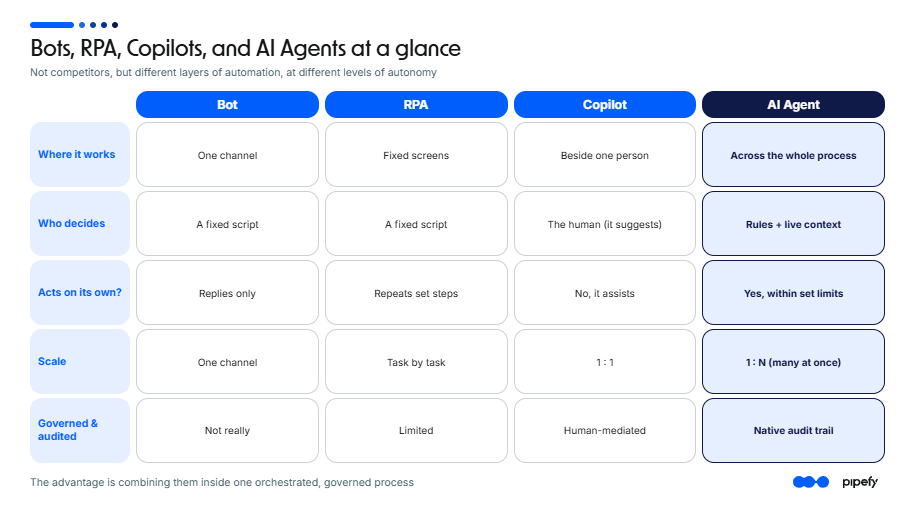
A bot operates within a single channel and answers predefined questions by following a fixed script. Bots were the first wave of conversational automation, and they remain useful for simple, repetitive exchanges.
An AI Agent operates across an entire process, not a single channel. Consider a customer support request: a bot replies with a standard response, while an agent reads the message, classifies its urgency, opens the ticket, and routes it to the right person.
One responds; the other interprets, decides, and executes.

AI Agents vs. RPA: same goal, different approach
This is the comparison that comes up most in my conversations with IT leaders, so precision matters. AI Agent vs RPA is not a competition but a division of labor. RPA (Robotic Process Automation) replicates human clicks and keystrokes across interfaces. It is well suited to repetitive, predictable tasks on interfaces that do not change.
However, when the interface changes, a document format varies, or the task requires judgment beyond “copy field A into field B,” RPA tends to fail. This is precisely where an AI Agent adds value: it makes decisions based on context and adapts when the process varies, with governed autonomy and a full audit trail.
In a procurement workflow, for example, RPA can populate the supplier record in the ERP, while the AI Agent validates the supplier’s documents, flags inconsistencies, prioritizes suppliers based on your criteria, and routes exceptions to a person for review.
Both operate within the same flow, in complementary roles.
See how this works across a full procurement cycle, orchestrated in Pipefy, from purchase request to supplier negotiation:
AI Agents vs. Copilots: who is in control
Copilots, such as the assistants built into text editors, IDEs, and email platforms, suggest text, summarize documents, generate code, and answer questions in real time. The interaction is always mediated by a person: the copilot suggests, and the human decides. A copilot works on a one-to-one basis and does not act on its own.
An AI Agent inverts that logic. You define the rules and limits up front, and the agent executes within them on a one-to-many basis, processing thousands of cases simultaneously. It runs the process while your team focuses on other work, always accountable through auditable records. In short, the copilot supports the work of an individual; the agent executes the process.
Control is exactly what executives are asking for. According to Capgemini, confidence in fully autonomous AI Agents fell from 43% to 27% in a single year, and nearly three-quarters of executives say the benefits of human oversight outweigh its costs.
Autonomy, in other words, scales only when it operates within defined rules and human checkpoints.
How to choose the right approach for your business
The perspective I share with IT and operations leaders is that most companies do not need to pick a single approach; they need to combine them.
A practical rule of thumb: automate predictable tasks with RPA, assign contextual decisions to AI Agents, and keep critical judgment calls with people. The table below maps four common scenarios to the most suitable approach:
| Your need | Best fit | Why |
| Answer frequent customer questions in chat | Bot | Standard answers, one channel, no contextual decision |
| Enter spreadsheet data into the ERP | RPA | Repetitive task, fixed interface, no variation |
| Summarize long emails before a meeting | Copilot | Point-in-time support for an individual, no autonomous execution |
| Classify contracts by risk and route them to the right approver | AI Agent | Contextual decision, multiple systems, governed end-to-end flow |
The real value emerges when agents operate inside orchestrated processes rather than as scattered tools. That is what AI orchestration means: a workflow, integrations with your systems, a decision layer of AI Agents, and governance holding it all together.
My colleague André Kano, Business Unit Manager at Pipefy, puts it this way:
Our understanding of AI implementation starts from the principle that the unit that delivers value to a company is the process. Companies do not produce results by performing a lot of separate tasks across departments; they deliver results when they establish repeatable processes that produce results at scale, consistently.
André Kano
Business Unit Manager at Pipefy
At Pipefy, this is exactly what we built. As a business orchestration and automation platform, Pipefy runs each process end to end and lets teams deploy AI Agents inside that flow with no code and under native governance: audit trails, access control, and the freedom to bring your own model.
The agent never operates in isolation, where it would become shadow AI; it works inside a process you can monitor and audit.
What this looks like in production: Roca’s success story
Roca, the century-old global leader in bathroom solutions, brought AI Agents into its HR operation on Pipefy instead of keeping HR requests scattered across email and spreadsheets.
By running hiring, onboarding, and self-service inside governed processes, the team saved more than 1,200 HR hours in 6 months, including a 640-hour reduction in onboarding effort.
Pipefy’s AI Agents added a new layer of efficiency to our processes. Just look at the more than 1,200 hours saved on HR tasks. We already use them across several routines, and the goal is to expand that use even further.
Willams Costa
HR Manager and leader of the Digital HR Project at Roca
- See also: Explore the real results of 10 companies that orchestrated their workflows with AI on Pipefy
Frequently Asked Questions (FAQ)
1. What are AI Agents in simple terms?
They are software systems that perceive the context of a process, decide the next step based on your rules, and act autonomously, within limits you set and with a full audit trail.
2. What is the difference between an AI Agent and RPA?
RPA runs fixed scripts on stable interfaces. An AI Agent makes context-based decisions and adapts when the process varies. They often work together, with RPA handling the predictable steps and the agent handling those that require judgment.
3. Are AI Agents the same as ChatGPT or Generative AI?
No. Generative AI creates content. An AI Agent makes decisions and takes action inside a structured, governed process.
4. Do AI Agents replace people?
No. You define the rules and boundaries, and the agent operates inside them. Critical judgment calls remain with people, which is why human-in-the-loop oversight is part of any sound design.
From concept to practice: how to put AI Agents to work in your processes
The key takeaway is that bots, RPA, copilots, and AI Agents are not competitors; they are complementary layers. The advantage comes from combining them through agentic orchestration, within governed processes.
To explore the topic further, download our guide, Automation with AI Agents: The Guide to Transforming Your Processes.
Inside, you will find:
- The foundations of AI Agents and how they differ from traditional automation;
- How to assess which of your processes are ready for agents;
- How to choose and train the right agents for the job;
- Practical applications by department;
- Best practices and governance for running agents at scale;
- Where AI Agents are heading next.