ARTICLE SUMMARY
Shadow AI is the use of generative AI tools at work without IT's knowledge, approval, or oversight, the AI-era successor to shadow IT. For enterprise IT leaders, it creates data-leakage, compliance, and audit-trail risks that call for a governance model, not a ban.
Every enterprise IT leader is facing the same quiet shift. The tools that run the business are no longer only the ones IT chose, provisioned, and secured. Employees now reach for whatever helps them move faster, and increasingly that means Artificial Intelligence.
A decade ago the problem had a name: shadow IT, the software and services teams adopted without going through IT. Today it has a successor. Shadow AI is that same instinct pointed at AI: people pasting company data into public chatbots, automating steps with unapproved agents, and letting models make decisions no one has reviewed. It is faster to start, harder to see, and far more consequential when it goes wrong.
The reflex is to lock it down. Banning AI rarely works, though. It pushes usage further out of view and widens the gap between what IT can see and what the business is actually doing. The more useful question for a CIO is how to bring shadow AI into the light, governed, auditable, and safe, without slowing the business that depends on it.
This guide is written for that decision. It covers what shadow IT and shadow AI are and why they are converging, why business teams turn to them, the governance risks they create, and the model that turns ungoverned AI into governed AI, including how an orchestration approach keeps the systems you already run firmly in place.
[E-Book] Automation with AI Agents: The Complete Guide to Transforming Your Processes
What shadow IT and shadow AI actually are (and why they are converging)
Shadow IT is any technology used inside a company without IT’s approval or oversight. It is the SaaS app bought on a corporate card, the spreadsheet quietly running a critical process, the browser extension, the personal cloud drive holding work files. None of it is malicious. It is simply work getting done outside the sanctioned stack.
Shadow AI is the same pattern applied to Artificial Intelligence. It is the use of AI tools, from public chatbots to autonomous agents, without IT’s knowledge, approval, or governance. An analyst summarizing contracts in a consumer chatbot, a manager automating approvals with an unvetted agent, a team wiring a public model into a workflow: each is shadow AI, and each sits outside the controls IT is accountable for.
The distinction is worth making precise, because the risks and the fixes differ in degree:
| Dimension | Shadow IT | Shadow AI |
| What it is | Unapproved software, SaaS, and cloud services | Unapproved AI tools, chatbots, and agents |
| Typical examples | Personal cloud storage, unvetted SaaS apps, spreadsheets running processes | Public chatbots summarizing documents, unreviewed agents automating decisions |
| Primary risk | Data stored in ungoverned tools, integration sprawl | Sensitive data sent to external models, unaccountable decisions at machine speed |
| Why it spreads | Faster than waiting on IT to provision a tool | Faster than waiting on a sanctioned AI tool, and often already embedded in familiar apps |
| What governance requires | Visibility, access control, a sanctioned alternative | The same, plus data controls, human oversight, and an audit trail for every AI decision |
The two categories are converging fast, and that is what makes this moment different from the SaaS sprawl of the last decade.
AI no longer arrives as a separate product you can gate at procurement. It ships inside the tools people already use, so every unsanctioned app is now a potential AI entry point, and every AI feature is a potential data exit.
In practice, today’s shadow IT is tomorrow’s shadow AI, and the boundary between them is dissolving.
The agentic wave raises the stakes further. Earlier shadow AI mostly meant a person querying a chatbot; increasingly it means autonomous agents that take actions, move data between systems, and trigger downstream steps on their own. An ungoverned chatbot leaks information. An ungoverned agent can act on it, which is a different order of risk for any IT leader accountable for what runs in production.
The scale is already hard to ignore. A 2025 analysis of more than 22 million enterprise AI prompts by Harmonic Security found that a meaningful share of sensitive-data exposure flows through personal, free-tier AI accounts that IT has no way to see. When usage is invisible, so is the risk, and invisible risk is the hardest kind to manage.
- Learn more: for a deeper definition of the term and how it took over from its predecessor, see the companion guide on what shadow AI is and why it is the new shadow IT.
Why business teams turn to shadow AI in the first place
It is tempting to read shadow AI as a discipline problem, but it is not. People adopt unsanctioned tools because they work, and because the approved path is too slow or does not exist yet. Treating it as misconduct misses the point and guarantees the wrong fix.
Look at the incentives. A business team has a deadline and a repetitive task that an AI tool can compress from hours to minutes. The sanctioned alternative may be a ticket in an IT backlog, a procurement cycle measured in weeks, or simply nothing at all. Faced with that gap, capable employees do what capable employees do: they solve the problem with whatever is at hand.
The drivers are remarkably consistent from one enterprise to the next:
- An IT backlog that pushes new requests weeks or months into the future.
- No sanctioned AI tool for the job, so the only option is a public one.
- Speed expectations reset by AI itself, where a task that once took a day is now expected in minutes.
- AI already embedded in familiar apps, adopted before anyone thinks to flag it.
For IT, the compounding effect is the real danger. Every ungoverned tool is a gap in the map, and the gaps do not stay isolated: they shape data flows, create dependencies, and quietly become load-bearing. By the time a shadow tool is discovered, the business already depends on it, which makes it far harder to bring under control than it would have been to govern from the start.
There is also a confidence gap that keeps this activity hidden. When people sense that AI use is discouraged, they stop asking and start quietly doing, which is precisely how usage slips out of view.
The result is a widening blind spot: the more valuable AI becomes to the business, the more of it happens where IT cannot govern it, and the larger the eventual exposure grows.
The strategic reframe is straightforward. The goal is not to shame users or win a game of whack-a-mole against new tools. It is to give the business a governed alternative that is as fast and as useful as the shadow option, so the sanctioned path becomes the path of least resistance. That is a governance challenge, and it is solvable.

The governance risk: data leakage, no audit trail, no oversight
The reason shadow AI deserves a CIO’s attention is not novelty, it is exposure. Ungoverned AI concentrates three risks that enterprise IT exists to manage: data leakage, a missing audit trail, and the loss of oversight over decisions.
1. Data leakage
Start with data. Public AI tools are only as safe as what people paste into them, and people paste a great deal. In Cisco’s 2024 Data Privacy Benchmark Study, 48% of professionals admitted entering non-public company information into generative AI tools.
Source code, customer records, contracts, and financials routinely cross into services the company never vetted, and in some cases into models that may retain or learn from them. Once that data leaves, it cannot be recalled.
That permanence is what sets AI leakage apart from a lost laptop or a misdirected email. Information absorbed by an external model can persist beyond the company’s reach, surface in outputs to other users, or fall under data-protection and sector regulations the enterprise is bound by. The incident is not a single event with a clean end, it is an ongoing exposure that is difficult to quantify and harder to close.
2. A missing audit trail
When AI runs outside sanctioned systems, there is no record of what data went where, which model was used, or how a given output was produced.
For a regulated enterprise, that is not just untidy, it is a compliance exposure: you cannot prove that a control was followed if no log of the action exists. It also cripples incident response, because when something does go wrong, there is no trail to reconstruct what happened.
3. Loss of oversight over decisions
An unreviewed model embedded in a workflow can approve, deny, or prioritize without anyone checking its logic, its bias, or its error rate.
In a bank, that might be a credit or fraud decision; in a hospital, a triage or eligibility step; in any enterprise, a hiring screen or a vendor approval.
Decisions get made at machine speed with no human accountable for them, which is exactly the scenario governance frameworks are designed to prevent.
This is the gap that IT governance software is meant to close: visibility into who is using what, control over data and access, and a complete, exportable record of every automated action. It replaces guesswork with a live picture of AI activity across the organization, which is the precondition for governing it at all.
Access is a large part of the answer. Service accounts are how IT grants governed, revocable permissions to automations rather than relying on personal credentials that no one tracks, so an agent’s access can be scoped, monitored, and switched off without touching a person’s login.
- Read more: The Pipefy Community breaks this pattern down in its explainer on technical fundamentals and service accounts.
From shadow AI to governed AI: what changes for the CIO
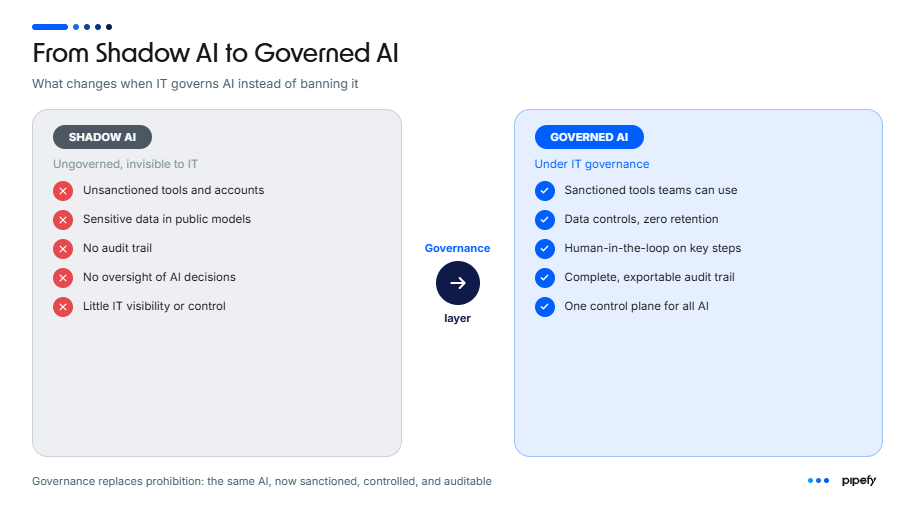
The shift every IT leader has to make is from prohibition to governance. A ban treats AI as a threat to be contained; governance treats it as a capability to be channeled. The first drives usage underground, the second brings it into a place IT can see and control. Governed AI is not slower AI, it is AI you can trust in production.
Concretely, governed AI means a few things at once: sanctioned tools that teams are allowed to use, clear data controls so sensitive information stays protected, human oversight on the decisions that carry judgment, and an audit trail behind every automated step. Instead of a scatter of personal accounts, there is one governed environment where AI operates, and one place for IT to set the rules.
In practice, governed AI rests on five requirements:
- Sanctioned tools the business is cleared to use, so people stop reaching for personal accounts.
- Data controls that keep sensitive information out of models that have no reason to see it.
- Human-in-the-loop review on the decisions that carry risk or judgment.
- A complete audit trail for every automated action, exportable for compliance.
- A single control point where IT can see and govern all AI and automation activity at once.
This also changes the CIO’s role. The mandate is no longer to be the gatekeeper who says no, but the enabler who makes the fast path also the safe path. When IT provides a governed way to use AI, shadow demand has somewhere legitimate to go, and the security posture improves precisely because adoption is encouraged rather than punished.
Making that real is an operating model, not a one-time policy. It pairs a clear, published stance on acceptable AI use with a sanctioned catalog of tools teams can adopt without a fight, and with enablement so people know where the safe path is and how to take it. Policy tells the organization what good looks like, the platform makes good the easiest option, and enablement closes the gap between the two.
The vehicle for this is a governed enterprise automation platform, where business teams get the speed they are chasing and IT keeps visibility, access control, and compliance. Telling a genuinely governed platform apart from a repackaged automation tool is its own exercise, and that companion guide breaks the evaluation criteria down in detail.
Governance also depends on how the platform connects to the systems you already run, because AI is only as governable as the data and processes around it.
- Learn more: orchestration matters as much as the model itself; the guide on Pipefy’s Integration Hub develops this for enterprise systems.
Underneath all of it sits a discipline many IT teams already know, process orchestration, applied here to AI.
How Pipefy governs AI Agents in production: a unified control plane, human-in-the-loop, and BYOLLM
Governed AI is only real if it holds up in production, and that is where Pipefy is built to operate. Rather than another place to run models, Pipefy provides the governance layer around them, so AI Agents can do meaningful work while IT keeps the controls.
At the center is a unified control plane that separates governance from execution. Every agent action is observable, auditable, and enforced against policy, so the business gains autonomy while IT retains a single point of visibility and control.
Through an adaptive governance framework, the platform is designed to eliminate the very shadow IT and shadow AI that ungoverned tools create, by giving people a sanctioned place to do the same work safely.
Oversight stays with people where it should
A Human-in-the-Loop Manager defines exactly when a person must review or approve, so agents act inside defined guardrails and safe zones instead of running unchecked. Routine steps clear automatically, while judgment calls, exceptions, and sensitive cases route to a human with the full context attached.
Observability is continuous, not periodic
Because agents run on the platform rather than in scattered personal accounts, IT can see which agents are active, what data they touch, and how each decision was reached, and can adjust policy centrally as the operation evolves. Governance becomes a live capability rather than an after-the-fact audit.
Control also means setting boundaries and having them hold
Role-based access, explicit policy rules, and per-agent permissions determine what each agent may see and do, so expanding AI use does not mean expanding exposure. The controls scale with adoption instead of eroding as it grows.
Data protection is equally explicit
Teams can bring their own LLM (BYOLLM) and keep the platform model-agnostic, backed by a zero data retention posture: your data is never used to train AI, and the AI does not access sensitive data it has no reason to touch. For regulated enterprises, that combination matters, because it lets the business use modern models without surrendering control over where data goes or how it is handled.
Controls backed by enterprise credentials
Pipefy is certified to ISO 27001, ISO 27701, and ISO 42001, with SOC 1 and SOC 2 attestations.
Most recently, it was named a Market Shaper in Gartner’s Emerging Market Quadrant for No-Code Agent Builders — Startup Vendors, a recognition tied precisely to running AI Agents inside governed processes rather than as loose, uncontrolled tasks.
- See also: if the concept of a governed agent is new to your teams, the Pipefy Community has a plain-language explainer on what AI Agents are and what they do in your process.
Orchestrating on top of your existing systems, without replacing your stack
There is a persistent myth that adopting a new platform means ripping out what you already have. For governance, the opposite is true. The goal is not to replace your systems, it is to orchestrate on top of them.
Pipefy acts as an orchestration layer, a system of engagement that sits over the core systems you already run, without a rip-and-replace project:
- It sits on top of your existing ERP, CRM, and HR platforms, which stay the record of truth.
- Pipefy governs the processes, approvals, and AI that operate across those systems.
- It connects through native iPaaS capabilities and 600+ ready-to-use connectors, so the business moves faster while your systems of record stay in place.
That architecture is also what makes governed self-service possible. Business teams build the automations they need as citizen developers, but strictly within the security parameters IT defines, so the business gains agility while IT keeps full visibility and compliance. This is the real answer to shadow IT at its source: not a tighter lock, but a better, sanctioned door that most people will happily choose.
Because it sits on top of the stack rather than inside it, the approach rolls out incrementally rather than as a single disruptive project:
- One team or process goes live under governance while the rest of the estate keeps running as it is.
- There is no big-bang migration and no risk to the systems of record.
- Each new use case connects when it is ready, under the same IT guardrails.
Success story: how BASF’s Agricultural Solutions Division eliminated spreadsheets and saved 2,400 hours with Pipefy
The pattern scales to the largest enterprises. At BASF, the Agricultural Solutions division used Pipefy to orchestrate research-and-development and product-launch processes, and what began in one area spread across the business:
- 20 integrated departments connected on a single platform.
- 1,000% growth in user adoption in a single year.
- 2,400 hours saved annually.
- 720 conditionals across 52 active processes, with more than 30% of records connected across pipes.
All of it runs under governance at global scale.
Improving our processes in a robust system has always been expensive and challenging. Pipefy is changing that. It’s a flexible platform that allows us to establish new processes and continuously improve the ones we already have.
Angela Miya
Launch Excellence Manager | BASF Latin America
This category has a name worth knowing, business orchestration and automation, the discipline of unifying people, legacy systems, and AI under a single control plane. The principle for IT leaders is simple enough to put on a slide: don’t replace your systems, orchestrate on top of them.
FAQ — Frequently asked questions about shadow AI governance
What is the difference between shadow IT and shadow AI?
Shadow IT is any technology, usually software or cloud services, used without IT’s approval or oversight. Shadow AI is the AI-specific case: employees using AI tools, chatbots, or agents outside IT governance. Shadow AI is essentially the next chapter of shadow IT, with a sharper data and decision risk, because the tools ingest sensitive information and then act on it.
Why is shadow AI riskier than traditional shadow IT?
A rogue SaaS app mostly stores data. Shadow AI actively processes it, and often sends it to external models that may retain or learn from it. It also makes decisions, which introduces bias, error, and compliance risk with no audit trail. The combination of data leakage and unaccountable, machine-speed decisions is what makes shadow AI a board-level concern rather than a nuisance.
Should we just ban shadow AI?
Banning tends to backfire. Prohibition does not remove the demand that created shadow AI, it just pushes usage into personal accounts and devices IT cannot see, making the problem less visible rather than smaller. A governance-first approach, offering sanctioned tools with proper controls, protects the enterprise while letting the business keep the productivity it is already getting from AI.
How can we bring shadow AI under governance without slowing the business?
Give teams a governed alternative that is as fast as the shadow option. A governed enterprise automation platform lets business users build and use AI within guardrails IT defines: sanctioned models, data controls, human-in-the-loop review, and a full audit trail. Speed and control stop being a trade-off when the sanctioned path is also the easiest one.
What should we look for in IT governance software for AI?
At minimum, look for a unified view of AI and automation activity, role-based access and service-account control, human oversight on sensitive steps, data protection such as zero retention and no training on your data, and enterprise certifications like ISO 27001 and SOC 2. The right IT governance software turns scattered, invisible AI use into one accountable, auditable system.
Does governing AI mean replacing our existing systems?
No. The strongest governance model orchestrates on top of the systems you already run rather than replacing them. Your ERP, CRM, and HR platforms stay the systems of record, while an orchestration layer governs the processes and AI that operate across them. You gain control and speed without the cost and risk of a rip-and-replace project.
Bring shadow AI under governance with Pipefy
Shadow AI is not a passing phase, and it will not be solved by a stricter policy memo. The organizations that come out ahead are the ones that stop trying to prohibit AI and start governing it, giving the business a fast, sanctioned path and giving IT the visibility, data controls, and audit trail the enterprise requires.
To help your teams get there, download our free guide, “Automation with AI Agents: The Complete Guide to Transforming Your Processes.”
Inside, you will find:
- The foundations of AI Agents, and how they differ from generative AI and rule-based automation.
- A practical framework to assess your processes and pinpoint the best automation candidates.
- How to choose and train agents, from autonomous agents to copilots, with the right controls.
- Ready-to-adapt use cases across Finance, HR, Marketing, Sales, Legal, Customer Support, and IT.
- A governance playbook, with the security controls, human oversight, and KPIs that keep AI accountable.