ARTICLE SUMMARY
Agentic AI for enterprise is the stage where AI moves from scattered tools to AI Agents that perceive context, decide within your rules, and act inside governed processes. With adoption already settled, it is what separates the companies that turn AI use into measurable business results.
For the past three years, the opening question in every enterprise AI conversation was whether the company had adopted the technology. In 2026, that question lost its edge. Artificial Intelligence is already in most operations, so using it no longer sets a company apart.
The new dividing line is what happens after adoption: whether AI operates inside the processes that carry the business, the approvals, the integrations and the systems where results are actually decided. This is the shift toward Agentic AI for enterprise, and this article looks at what the data says about who is crossing it, and how.
[Pipefy AI Research] From AI Adoption to Agentic Orchestration: the next stage of Artificial Intelligence in enterprise operations
Adoption is settled: why using AI no longer sets a company apart
The numbers make the point. In an exclusive Pipefy survey of 148 companies across the US and Brazil, 67.1% of the US companies already use AI in some process. Across the wider economy, the US Census Bureau Business Trends and Outlook Survey recorded 19.8% of American businesses using AI in May 2026, a share that reaches roughly 37% among companies with 250 employees or more.
The frontier has also moved from assistants to agents. Gartner estimates that 40% of enterprise applications will feature task-specific AI Agents by the end of 2026, up from less than 5% in 2025.
Saturation brings noise. Nearly every vendor now advertises AI Agents, and Gartner has named the practice of repackaging old automation as autonomous agents: agent washing.
That makes the real question harder to answer, as André Kano, Business Unit Manager at Pipefy, puts it:
All the companies are talking about the same thing, they are talking about AI. The question is: what, then, is the difference between all the companies offering AI solutions to the market?
André Kano
Business Unit Manager at Pipefy
The difference, as the rest of the data shows, is no longer adoption. It is orchestration and governance.
The visibility gap: you can’t govern what you can’t see
The first obstacle between use and result is what the organization cannot see. In Pipefy’s exclusive survey, when asked how much team time goes into handling unstructured data, the most frequent answer among US companies was not a number. It was “I don’t know,” chosen by 27.4% of respondents.
That blind spot has a governance cost. In the same survey, 34.2% know that employees use public generative AI with no control, visibility or policy, and another 21.9% do not know how the company handles the practice. This is how shadow AI spreads: not through a central decision, but through the sum of individual initiatives.
You cannot govern what you cannot see, which is why visibility is the precondition for scaling AI safely. The discipline behind it is worth its own read, in the guide on Shadow IT and Shadow AI governance.

The swivel-chair operation: more tools, less integration
Even where AI is in use, the operation underneath is often fragmented. In the US survey, 42.6% of companies still access multiple systems and screens to complete a single process, and only 6.6% run processes that are fully orchestrated end to end.
This is the swivel-chair operation: people re-keying the same data from one tool to another, with no single record of the cycle. Adding AI to it does not fix the fragmentation; it accelerates it. The table below shows the contrast:
| Dimension | Isolated automation (swivel-chair) | Agentic AI for enterprise (orchestrated) |
| How work moves | People re-key data across tools and screens | One governed flow across systems |
| Visibility | Fragmented, no single record of the cycle | End-to-end audit trail |
| Exceptions | Break or bounce back to manual | Routed to a human, with context |
| AI Agents | Run off to the side, ungoverned | Execute inside the process, with guardrails |
| Outcome | Local speed-ups | Measurable, scalable results |
The gap is not the model; it is the architecture around it. Closing it is the job of an AI process automation platform that runs the process across systems, rather than one more tool bolted onto the stack.

What actually decides the purchase: ease of adoption before ROI
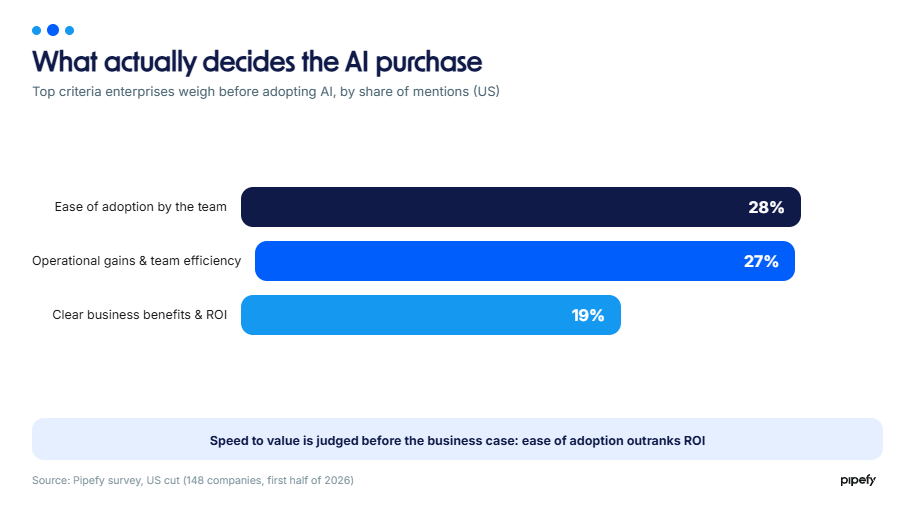
One finding reframes the buying conversation. In Pipefy’s exclusive research, when US companies list the criteria they weigh before adopting a technology like AI, ease of adoption by the team leads with 28% of mentions, ahead of operational gains and team efficiency (27%) and clear business benefits and ROI (19%).
In other words, speed to value is judged before the business case. It helps explain why long implementation projects lose internal sponsorship, even when the expected return is well documented, and why intelligent automation that ships in weeks beats a heavier program that takes quarters.
That bias toward speed sits on top of a harder problem: proving return at all. According to a BCG study cited by MIT Sloan Review Brazil, 74% of organizations worldwide cannot show tangible financial impact from AI.
When AI runs in silos, the value is real but nearly impossible to measure. When it runs inside an orchestrated process, the result becomes visible and auditable, which is exactly the case for evaluating an enterprise AI platform on governance, not features alone.
From isolated automation to Agentic AI for enterprise
Put the findings together and a clear path appears. Adoption is settled, visibility is the gap, the operation is fragmented, and buyers reward speed to value. Agentic AI for enterprise answers all four by moving AI out of isolated tools and into governed, orchestrated processes.
That is also where the consensus on autonomy lands. In Pipefy’s exclusive survey, 57.4% of companies see the human as the orchestrator and validator, and 34.4% would delegate to an AI Agent as long as the rules are well defined and auditable.
Autonomy, in other words, is welcome when it is supervised. As Renato Hartz, Head of Business Units at Pipefy, frames the competitive point:
Building an agent is easy. There are more than 100 players in the market today, globally, that build AI Agents. The hard part is orchestrating that intelligence. That is the real challenge, and it is where we place our bets.
Renato Hartz
Head of Business Units at Pipefy
This is the model Pipefy is built on. As a business orchestration and automation platform for enterprise IT, it acts as a unified orchestration layer over your systems of record (ERP, CRM, HCM), connecting to them through APIs and native iPaaS without rip-and-replace.
AI Agents execute inside that flow, under an adaptive governance framework with audit trails, access control and human-in-the-loop, which is what eliminates shadow AI while keeping the core intact.
The recognition follows the model: Pipefy was named among the Market Shapers in the Gartner report Emerging Market Quadrant for No-Code Agent Builders — Startup Vendors, which underscores Pipefy’s role in building AI Agents that run inside governed processes, with audit trails, access control, and Human-in-the-Loop, rather than operating as loose, uncontrolled tasks.
- See also: If integration is your first concern, this buyer’s guide to legacy system integration without downtime covers what to demand from a vendor.
Success story: how Puma automated onboarding end to end with Pipefy
Puma, the global sporting goods brand, is a clear example of moving from scattered automation to a governed, orchestrated operation. Its HR team faced a manual onboarding sequence that could not keep pace with continuous hiring.
Instead of adding point tools, Puma orchestrated its processes on Pipefy, layering AI document reading on top of existing systems. It now runs more than 29 active processes across over 10 departments, automated 100% of employee onboarding into a 21-day workflow, and executed more than 10,000 automated actions in a single year, accelerating 40 to 50 hires a month with 90% accuracy in AI-powered document reading.
Today, practically all of our processes are automated, such as hiring, vacations, terminations, and the request portal for Corporate and Retail. This gave us visibility into the volume of requests we handled monthly and annually. These metrics are now part of the indicators we present to the company’s executive leadership. In the hiring process alone, using AI for document reading, we estimate a gain of around 10 hours per month.
Wanderson Andrade
Project Lead at Puma
The next stage of your operation starts here
The conclusion from the data is direct: using AI no longer sets a company apart. What does is orchestrating it end to end, with AI Agents that operate under governance and results you can actually measure.
To see the full picture, read Pipefy’s exclusive report — From AI Adoption to Agentic Orchestration: the next stage of Artificial Intelligence in enterprise operations —, built on proprietary data from Pipefy’s survey of its customer base and set against the wider market.
Inside, you will find:
- Why using AI no longer sets a company apart, and what does now.
- The visibility gap: what leaders cannot see, and therefore cannot govern.
- Where AI already delivers: the priority of back-office processes.
- Supervised autonomy: the conditions the market has set for humans and AI.
- From isolated automation to agentic operations at scale, and the role of orchestration.