ARTICLE SUMMARY
AI ROI is the measure of the return that Artificial Intelligence generates on what was invested in it, translated into business indicators such as cycle time, cost per transaction and freed capacity. It becomes measurable only when AI runs on an architecture that can orchestrate and govern the process end to end.
Enterprise AI has moved into its proof stage. After three years of adoption, the question US leaders face is no longer whether to use Artificial Intelligence, but whether it returns more than it costs, and whether the platform running it can prove that return.
According to Google Cloud, 86% of executives already say AI drives growth without a proportional rise in operating costs. The open question is where that growth shows up, and how to measure it.
Proving it is the hard part. In most US operations, AI is already running, but it sits on a fragmented stack, which makes the architecture around the model, not the model itself, the thing that decides whether a return ever appears.
For IT, this turns AI ROI into a number the team has to defend, usually alongside the platform and the vendor it chose to run on.
At a recent Pipefy event with Google Cloud, Marcus Moura, General Manager of the Finance & Risk BU, and João Moreira, General Manager of the Insurance BU, both at Pipefy, discussed the topic in depth. Their shared point: AI only turns into ROI when it runs inside processes, not in isolated tools.
[Pipefy AI Research] From AI Adoption to Agentic Orchestration: the next stage of Artificial Intelligence in enterprise operations
Why most companies still can’t prove AI ROI
The market conversation has moved from adoption to return. The most common explanation for the distance between investment and result tends to blame the model, data quality or the maturity of the team. The US data points to a more structural, and more correctable, cause: the architecture around the model.
That diagnosis comes from Pipefy’s own data. The second edition of the Pipefy AI Research, an exclusive survey of 148 companies from its customer base in Brazil and the United States, shows AI deployed into operations that do not yet run as a continuous flow.
Among the US companies, 42.6% still access multiple systems and screens to complete a single process, and only 6.6% run processes that are fully orchestrated end to end. When a business area needs to automate a new workflow, the main barrier is not the model either: 32.8% point to integrating legacy systems with AI platforms as the greatest difficulty.
The market is already pricing that in. According to Gartner, more than 40% of agentic AI projects will be canceled by the end of 2027, with escalating costs, unclear business value and inadequate risk controls among the leading causes.
Vendor risk is part of the story: the same analysis flags “agent washing,” the rebranding of older automation as autonomous agents, and estimates that only about 130 of the thousands of agentic AI vendors are real.
A minority is already on the other side. In Google Cloud’s survey of more than 2,400 executives, 84% report increasing financial returns from AI, yet only 26% see those returns accelerate year over year, the cohort it calls “AI ROI Leaders.” What sets them apart is less the model they picked and more how they measure the return and where they let AI run.
This is the blind spot of AI ROI. When AI runs on top of a disconnected stack, the gain is real, but it stays scattered and invisible to leadership. Without a single flow that records the before and the after, there is no baseline to compare against, and the return never shows up in the report.
This is also the dividing line of agentic AI for enterprise: the stage where AI moves from scattered tools into governed processes that produce measurable results.
As Alessio Alionço, founder and CEO of Pipefy, framed it in the research:
Most teams already use Claude or ChatGPT, they have experimented and built things internally. But they realized very quickly that for mission-critical work, such as credit analysis, reimbursement or executing a payment, you need far more control and observability.
Alessio Alionço
Founder and CEO of Pipefy

The 5 metrics that actually measure AI ROI
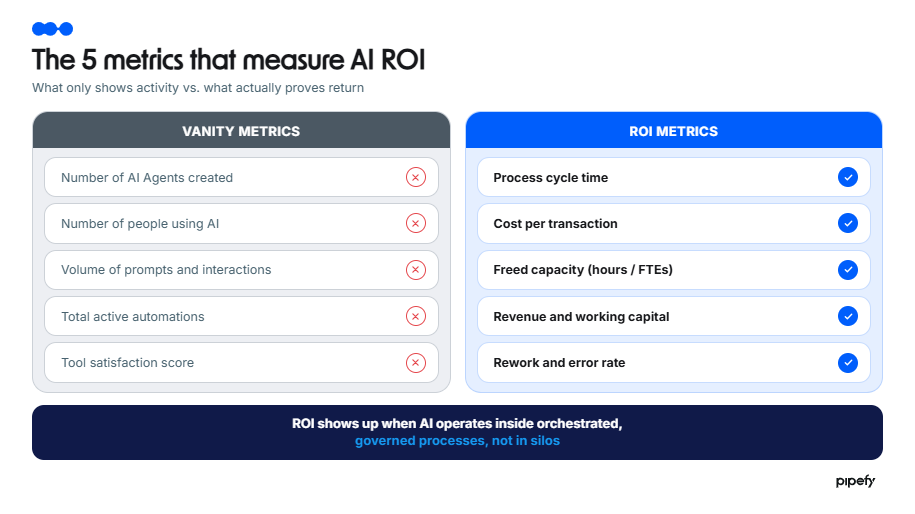
The first measurement error is counting what does not matter. Number of AI Agents created, number of people using AI and volume of prompts are vanity metrics: they show activity, not result. AI ROI is measured by business indicators that already existed before AI.
Five metrics are the ones that truly translate return:
- Process cycle time, from start to finish, before and after AI.
- Cost per transaction, including token consumption and labor hours.
- Freed capacity, measured in hours or in FTEs (Full-Time Equivalents) reallocated to higher-value work.
- Revenue and working capital, when AI accelerates steps that lock money inside the operation.
- Rework and error rate, which falls when the rule is applied consistently.
The table below separates what only looks like progress from what proves return:
| Vanity metric | ROI metric |
| Number of AI Agents created | Process cycle time |
| Number of people using AI | Cost per transaction |
| Volume of prompts and interactions | Freed capacity, in hours or FTEs |
| Total active automations | Revenue and working capital |
| Tool satisfaction score | Rework and error rate |
The principle holds for any IT operations automation initiative: what counts is the change in the indicator, not the number of automations. Measuring the gain requires comparing the same process before and after, against a defined baseline.
The three dimensions of AI ROI: quality, financial and speed
When the return appears, it shows up in three dimensions at once: quality, financial and speed. Understanding each one helps in choosing the right metric to prove the gain.
The pattern is broad: in the same Google Cloud survey, 94% say AI Agents already contribute to both reducing costs and generating revenue, which is why the return rarely comes down to a single line on the balance sheet.
1. Quality: less error and less rework
The first dimension is the quality of what the process delivers. When AI operates inside a governed flow, the same rule is applied to every case, which reduces exceptions, inconsistencies and decisions that depend on each person’s individual judgment.
The practical effect shows up in the error rate and in the volume of rework. Fewer reports redone, fewer records sent back and fewer approvals reversed represent a lower cost of non-compliance, one that used to go unnoticed in the business case.
2. Financial: lower cost per transaction and more working capital
The second dimension is the financial one, and it is the one the CFO reads directly. Cost per transaction falls when AI eliminates hours of manual work and keeps token consumption under control, inside a process that records every step.
There is also a less obvious gain: working capital. When AI accelerates steps that lock money inside the operation, such as approving a line of credit or issuing an invoice, cash is released faster, and the return stops being only cost reduction to become capital efficiency.
3. Speed: cycles that drop from days to minutes
The third dimension is speed. With AI executing inside the flow, cycle time tends to fall to less than half, and in high-volume processes it reaches a third or less of what it was.
The caveat matters: speed only holds when the process is orchestrated end to end. Accelerating an isolated task while the rest stays manual simply moves the bottleneck to the next step, without shifting the final indicator.
In practice, at least two of these dimensions tend to come combined: quality rises while cost falls, or cost falls while the cycle shortens. It is that combination that turns automation into a return visible in the indicator, and not just a perception of agility.
On stage at Google Cloud’s recent event, Marcus Moura summed up the point:
How do you actually generate real, measurable, tangible results? Nothing works better than having that already embedded inside a journey that already exists, a flow that already exists, a pain that already exists.
Marcus Moura
General Manager of the Finance & Risk BU at Pipefy
Why ROI shows up when AI runs inside orchestrated, governed processes
There is a cost that rarely enters the business case: the time spent before the process even begins. In Pipefy’s US survey, among the companies that measure it, 15.1% report that more than half of their team’s time goes into handling unstructured data, such as reading emails, extracting values from PDFs and checking spreadsheets. More telling still, 27.4% cannot even quantify it, the single most frequent answer. It is exactly the kind of task AI executes with efficiency, as long as it has governed access to the data inside the flow.
That is why the return appears when AI runs inside orchestrated, governed processes, not in silos. Orchestrating over the legacy stack keeps ERPs and CRMs as the system of record and connects systems, people and AI Agents in a single flow.
Native governance, with the rule applied and an audit trail at every step, is what makes the result traceable and, therefore, measurable. The guide on agentic orchestration details why the orchestration layer is where the value now concentrates.
It also reframes the buying decision. When the surrounding architecture is what produces or hides the return, the platform is evaluated on integration, data access and interoperability, not on a feature list. That is the practical meaning of vendor risk, and the subject of the buyer’s guide to legacy system integration without downtime.
At the same Pipefy and Google Cloud event, João Moreira translated the positioning:
Your company doesn’t run on prompts, it runs on processes. And we are able to orchestrate AI Agents and automate processes with governance in highly regulated industries like financial services and insurance.
João Moreira
General Manager of the Insurance BU at Pipefy
How Pipefy makes AI ROI measurable
It is this model that supports Pipefy as a platform for IT operations. Instead of adding one more tool to the stack, it acts as the business orchestration and automation layer over your systems of record, connecting to ERPs, CRMs and HR systems through APIs and native iPaaS, with no rip-and-replace.
That is also the answer to vendor risk: the core stays in place, and the layer you evaluate is judged on architecture and interoperability.
Inside that layer, AI Agents execute under a rule and an audit trail. They are built in Pipefy Agent Studio with explicit decision boundaries and human review wherever risk requires it, while Intelligent Document Processing turns emails, PDFs and spreadsheets into structured data before the decision steps, which addresses the time teams lose to unstructured data.
Governance is built in, with role-based permissions and audit trails, and the architecture stays provider-agnostic, in a bring-your-own-LLM approach where customer data is not used to train models.
The return was also quantified by Forrester in The Total Economic Impact™ of Pipefy (2024): 260% ROI, 40% of time saved on automated tasks, 50% reduction in development time and payback in under 6 months.
Pipefy has also been named among the Market Shapers in the Gartner® “Emerging Market Quadrant for No-Code Agent Builders — Startup Vendors”, which underscores Pipefy’s role in building AI Agents that run inside governed processes, with audit trails, access control, and Human-in-the-Loop, rather than operating as loose, uncontrolled tasks.
Success story: Stanley cuts its credit cycle from 25 to 7 days with AI Agents
Stanley, a US manufacturer, is an example of how the return becomes visible when AI operates inside a governed process. The company’s credit and risk analysis depended on spreadsheets and score calculations done by hand, with a cycle that reached 25 days and consumed as much as two days of skilled work just to score each supplier.
By rebuilding the process in Pipefy, Stanley put 5 AI Agents into production to read credit bureau reports, interpret documents and write the credit reports, with a confidence score that routes the cases below the cutoff to human review.
The result shows up exactly in the ROI metrics: capacity equal to roughly 48 FTEs reclaimed, the credit cycle cut from 25 to 7 days, a 72% drop, and supplier scoring falling from 2 days to 1 minute.
The AI-agent credit analysis workflow saves us about a day of work for every document we review. And once people see results like that, adoption spreads fast.
Daniel Molina Gil
IT and Business Lead | Stanley LATAM
Start with the right measurement and the right architecture
AI ROI is not proven by the number of agents, but by business metrics that already existed. Those metrics only become visible when AI runs inside orchestrated, governed processes, on top of the infrastructure the company already uses.
This is the layer Pipefy delivers. By orchestrating ERPs, systems, people and AI Agents in a single, auditable flow, the platform turns every step into data and gives leadership the before and the after that the return calculation requires, trading the estimate for the measurement.
It is also how the platform answers for itself: the same architecture that makes the operation measurable is what makes the vendor accountable for the result.
This is the path that Pipefy’s exclusive report details with data from the US enterprise market. For the full picture, read From AI Adoption to Agentic Orchestration: the next stage of Artificial Intelligence in enterprise operations, built on proprietary data from the research Pipefy conducted with its own customer base, set against wider market data and discussions.
Inside, you will find:
- Why using AI no longer sets a company apart, and what does now;
- The visibility gap: what leaders can’t see, and therefore can’t govern;
- Where AI already delivers: the priority of back-office processes;
- Supervised autonomy: the conditions the market has set for humans and AI Agents;
- From isolated automation to orchestrated operations at scale, and the role of orchestration.