ARTICLE SUMMARY
An IT modernization strategy is the plan for upgrading enterprise technology to meet new demands without breaking what already works. For legacy-heavy enterprises, the smartest path is rarely a full replacement. It is modernizing in layers and orchestrating people, systems, and AI Agents on top of the stack you already run.
Every enterprise IT leader is under pressure to modernize. AI raised the bar, business teams want speed, and the systems of record that run the company were never designed to talk to each other. The instinct is to rip out the old stack and start fresh, and it is usually the wrong move.
Modernization is accelerating, but not toward replacement. According to Gartner, spending on business orchestration and automation technology will climb from nearly US$ 7 billion in 2025 to more than US$ 21 billion by 2029, as enterprises invest in a layer that connects what they already run instead of tearing it down.
A sound IT modernization strategy in 2026 starts from a simple principle: don’t replace your systems, orchestrate on top of them. The goal is not a new core, but a governed layer where people, systems, and AI Agents work in a single flow.
This roadmap covers what modernization really means today, why rip-and-replace is the costliest path, the four layers of a practical plan, how to orchestrate legacy systems instead of replacing them, and how to tell when your organization is ready.
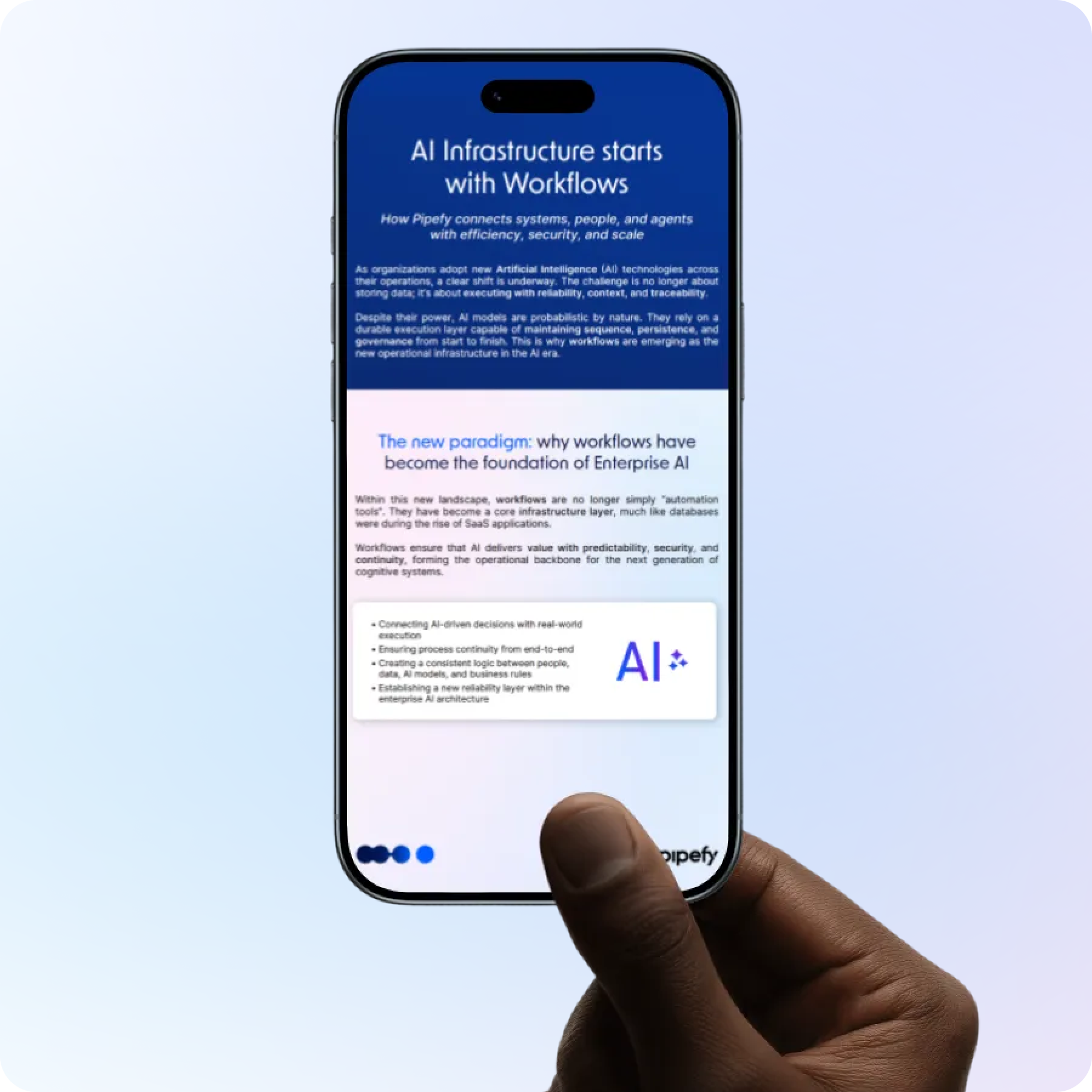
[One-Pager] AI Infrastructure starts with Workflows: How Pipefy connects systems, people, and AI Agents with efficiency, security, and scale
What IT modernization means in 2026 (and what it does not)
Modernization in 2026 is not about swapping your ERP for a newer one. Your systems of record are usually fine. The problem is what happens between them: the manual handoffs, the email approvals, the reconciliation living in spreadsheets, and the lack of a trail across the whole process.
So modernizing means closing those gaps. It means making critical systems work together, adding governed AI where it removes real effort, and giving IT visibility and control over processes that today run in the dark.
What it does not mean is disruption for its own sake. Replacing a stable core to chase a modern interface trades a known system for migration risk, downtime, and lost process knowledge. The modern move is to extend the life of what works and orchestrate the rest around it.
AI is what makes this urgent in 2026. Every team now wants to add agents, but an agent that runs outside a governed process just creates one more silo. Modernization, in practice, means building the layer where those agents, your systems, and your people operate under the same rules and the same visibility.

Why rip-and-replace is the most expensive decision you can make
Rip-and-replace looks like progress, but it is the costliest path an enterprise can take. Innovating inside a rigid core ERP can cost 18 months and upwards of US$ 500K before a single new process reaches users, and that is before counting downtime and retraining.
The deeper problem is that replacement rarely fixes the real issue. Swapping one system of record for another still leaves the gaps between systems untouched. The work that falls through the cracks, the missing audit trail, and the manual glue between tools all survive the migration.
There is also the cost of lost momentum. While a multi-year replacement project runs, the backlog grows and business teams route around IT with their own tools, which is exactly how Shadow IT and Shadow AI take hold. Modernization that takes years to show value tends to create new risk faster than it retires old risk.
There is a quieter cost, too. A replacement resets years of accumulated process knowledge: the exception handling and business logic that live in how your teams actually work. That institutional memory rarely survives a migration intact, and rebuilding it is slow and expensive.
The 4 layers of a modernization roadmap: data, integration, process, governance
A resilient IT modernization strategy avoids rip-and-replace by working in layers. Each one builds on systems you already own, and each can deliver value on its own.
| Layer | What it covers | The goal |
| Data | Reliable, accessible data in your existing systems of record | Keep the core as the source of truth, no migration required |
| Integration | Connecting systems through APIs and native iPaaS | Make legacy systems exchange data without custom code |
| Process | Orchestrating the work across systems in one governed flow | Turn scattered tasks into a single, repeatable process |
| Governance | Audit trails, human-in-the-loop, access control, and compliance | Prove every decision and eliminate Shadow IT and Shadow AI |
The process layer is where the value compounds. Once the data flows and the systems connect, orchestrating the work across them turns scattered tasks into one repeatable process, the unit that actually delivers a result. It is also where AI Agents earn their place, executing steps inside a flow that already has rules and owners.
The integration layer is where most modernization stalls, because point-to-point connections are slow to build and fragile to maintain. Doing it well is the heart of any legacy system integration effort, and it is what lets the process layer run end to end.
The governance layer is what separates a durable modernization from a risky one. When control is built into the process, not bolted on afterward, IT can scale automation and AI without losing the trail.
- Read more: For a deeper view of that discipline, see the guide on Shadow IT and Shadow AI governance.
How to orchestrate legacy systems instead of replacing them
Orchestration is the answer to the layers above. Instead of replacing your systems of record, you add a system of engagement over them: a layer that reads from and writes to your ERP, CRM, and core banking through APIs and connectors, and runs the process across all of them in one place.
This is exactly what Pipefy does. As a business orchestration and automation platform, it sits over your systems of record as a system of engagement, connecting to your ERP, CRM, and core banking through APIs, native iPaaS, and 600+ pre-built connectors. It then runs each process end to end in a single governed flow, so the work that used to jump between systems and inboxes happens in one place, with a full audit trail.
Inside that flow, Pipefy lets IT deploy AI Agents that execute steps, read documents, and extract data, always within the rules and permissions of the process. The point is not to build one more agent in isolation, but to let the process govern the agents, the systems, and the people together. That is how modernization happens without touching the core: the platform extends the lifecycle of your existing investments instead of replacing them.
This is the core of the orchestration-first approach. As André Kano, Business Unit Manager at Pipefy, puts it:
More than just adding one more agent builder to the market, what Pipefy proposes is the idea that the process is what should govern and orchestrate not only the AI Agents, but also the systems it connects to and, of course, the people who deliver results within that same process.
André Kano
Business Unit Manager at Pipefy
The payoff is measurable. Forrester’s The Total Economic Impact™ of Pipefy found a 260% ROI with a payback period under 6 months, and enterprises typically take a first critical use case live in about 14 days rather than months. In one case, a large enterprise consolidated 15 separate tools into a single orchestration layer, without replacing the systems underneath.
Because the control lives in the process, this approach also answers the governance question that stalls most AI programs. If you are still weighing platforms, the companion guide on workflow orchestration tools explains how to evaluate governance, not just automation.
Case in point: a global technology company that modernized on top of its systems
A global technology company with more than 10,000 employees faced a familiar problem in its customer success operation: the systems existed, but they did not connect. Processes were fragmented, with no end-to-end visibility, which slowed decisions and made continuous improvement hard.
Instead of replacing anything, Fujifilm used Pipefy to structure customer success management in a single environment, connecting existing workflows and layering in automation and AI.
The team expanded the platform to more than 50 processes across 13 departments, optimized 1,600+ hours with automation, and set a milestone of up to 30% less lead time in its more complex workflows.
As Vanuza Yokoyama, Customer Success Manager at Fujifilm, summed it up:
Pipefy was essential to implementing the Customer Success area at Fujifilm, ensuring clear processes, fast decisions, and consistent experiences for our customers and suppliers, accelerating our digital transformation.
Vanuza Yokoyama
Customer Success Manager at Fujifilm
Signs your organization is ready to modernize
Modernization does not start with a budget cycle. It starts when the pain becomes visible. A few signals that your organization is ready to move:
- Your critical systems don’t talk to each other, and integrations take months to build.
- The real work happens between systems, in email threads and spreadsheets, with no audit trail.
- Business teams are adopting their own AI tools, and security cannot see what is running.
- IT has a growing backlog and cannot keep up with automation demand.
- Audits turn into a scramble to reconstruct who decided what, and when.
If several of these sound familiar, the gap is not your systems of record. It is the missing orchestration layer between them. That is good news: it means you can modernize without touching the core, starting with a single high-volume process and expanding under the same governance.

Modernize on top of your stack with Pipefy
Pipefy is a business orchestration and automation platform built to sit over your critical systems, not replace them. It connects ERP, CRM, and core banking through 600+ connectors and native iPaaS, runs each process end to end in one governed flow, and lets IT deploy AI Agents that execute inside the process with a full audit trail from day one.
That combination is why Gartner named Pipefy one of the Market Shapers in its Emerging Market Quadrant for No-Code Agent Builders — Startup Vendors. The model is simple to state: business users build, IT governs, and AI executes, all on top of the systems you already run.
To go deeper, the one-pager AI Infrastructure starts with Workflows: How Pipefy connects systems, people, and AI Agents with efficiency, security, and scale lays out the full picture.
Inside, you will find:
- Why workflows are becoming the core infrastructure layer of the AI era, much as databases were during the rise of SaaS.
- How to orchestrate systems, people, and AI Agents in a single governed flow, on top of the tools you already run.
- The governance built in for enterprise scale: immutable logs, granular access controls, SSO, MFA, and audit trails.
- Multi-LLM flexibility to choose the best model for each use case, with full security and no lock-in.
- The business impact to expect, from up to 40% faster execution of complex processes to end-to-end visibility.
[One-Pager] AI Infrastructure starts with Workflows: How Pipefy connects systems, people, and AI Agents with efficiency, security, and scale